Rajbrot
Borough of Murowana, Bocheński District, Małopolskie Voivodship Type of placeType of place
A private plot.Information about the crime
A young Jewish woman from Rajbrot was murdered in the forest. She came from one of the few Jewish families in that village. The body was buried at the site. The location of the grave was possible thanks to the precise indication of the descendant of the man who buried the woman’s body. Anna Brzyska, a memory activist from Brzesko and a long-time caretaker of the local Jewish cemetery, recorded the account of a resident of Rajbrot:
“The daughter of a man who buried a murdered Jewish girl remembered this place. This is the second person who told me about this case. This man worked in the field and that’s why he was ordered to bury the murdered girl. She was murdered in this grove and buried here, using the strength of the man who worked in the field. I suppose she was local because there were several Jewish families in Rajbrot before the war.” (Rajbrot, April 6, 2021)
In 2009, a historian Łukasz Krzyżanowski wrote an article about the Rajbrot massacre. He gathered information about this event from eyewitnesses:
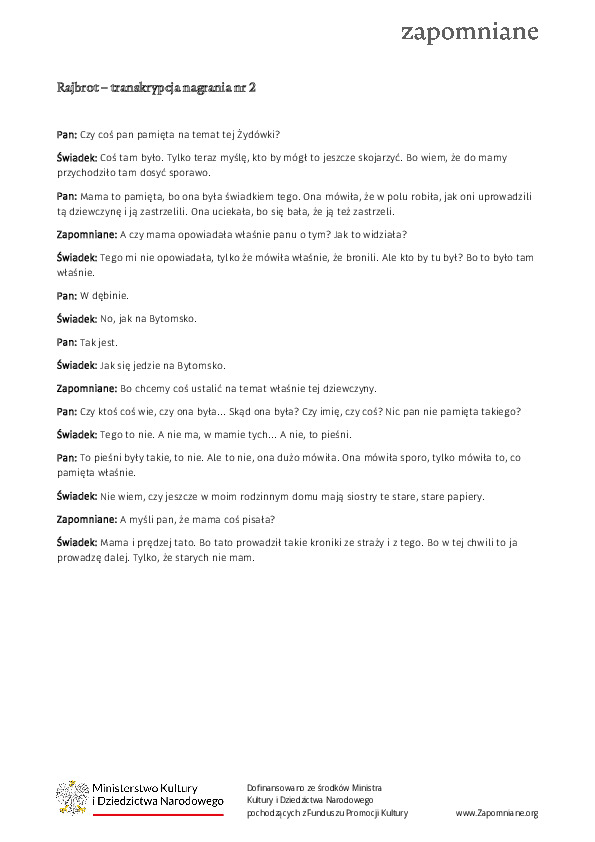
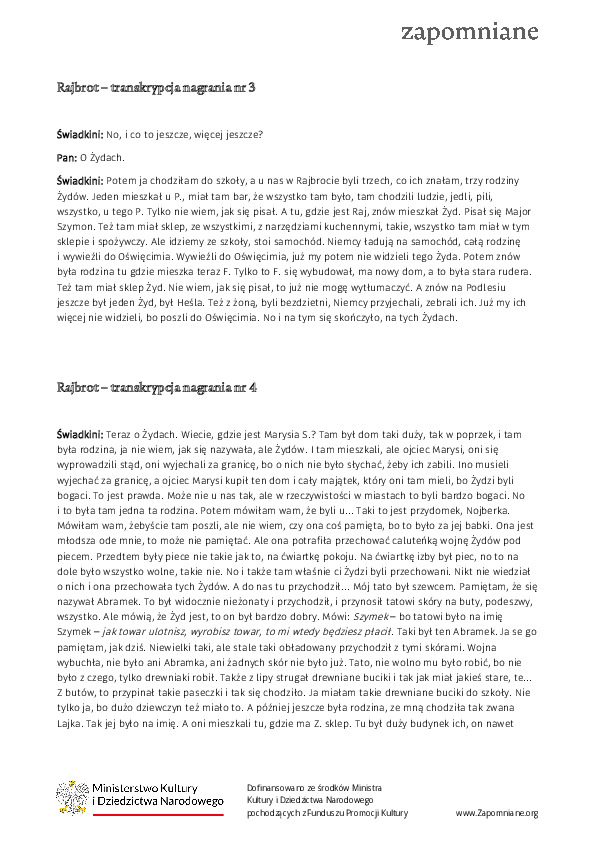
“I was grazing cows and I was looking at them, and they shouted at me, ‘Don’t stare!’ […] They were leading this girl away in her petticoat. She was little. Maybe 13 or 14 years old. They called her Małka. A Jewish girl. […] She was hiding here somewhere. She came to the dairy. My uncle worked there. He gave her some cheese to eat and some milk to drink. She was so hungry! Oh! They led a Jewish girl from that dairy away to her death in just a white petticoat. It was so miserable. […] I know where they buried that Jewish girl. We can go there. […] Two of them were leading her away. Two Poles in German uniforms. One of them was named B. People said he had nine deaths marked on his revolver. I was grazing cows there. There were two shots. I think it was in the fall, but I don’t know which year. There were no Jews in the village by then. […] It must be here somewhere. They buried her here. K., the shoemaker, worked here in the field. They told him to dig a hole. Somewhere near that herringbone tree. […] They led Małka to her death in her underwear. Little Małka. I don’t know if they ordered her to take off her dress before her death, or if they gave her something to eat at the dairy, and she left it there, knowing she would die… K. wore her dress afterward.” Another resident quoted in the article recalls that after the war, the grave was cared for by children, probably students from the local school: “Children used to go here to decorate the grave, but now we don’t know exactly where it is.”
In 2024, we conducted another site visit in Rajbrot. We met with several residents who knew the story of the murdered Jewish girl from their parents’ stories. We talked to the daughter of the man who buried the body:
“Zapomniane: Have you heard anything about this murdered Jewish woman?”
– Yes, I have, my dad buried her. […] But there’s a plaque there. [a wooden matzevah].
Zapomniane.: Is the plaque in the right place?
– Yes.
Zapomniane.: And what did your dad say about it? Because we wanted to learn more about this girl.
– Only that they brought her because they were Germans, yes. They were leading her, and he was in a field. So what? It was dust And he had to bury her.
Zapomniane.: And who did he bury her with?
– Alone.
Zapomniane.: But did he say whether she was a child, a teenager, or a young woman?
– She was a young woman.
Zapomniane.: He didn’t know her from before. War? Wasn’t she some local Jewish woman?
– No.
Zapomniane: Did your dad ever go back to that place? Did you go there? To the place where she was buried?
– It was right next to our field. We’d just pass by there, there was a road there, and so on, every day…
Zapomniane: And when you passed by there with your dad, did your dad tell you about that place?
– No.
Zapomniane: Didn’t he mention it?
– He didn’t mention it. He had no choice, he had to bury it, and cover it with earth, and that’s it.
Zapomniane: Do you remember if anyone ever went there to light a candle?
– Children. Parents kept repeating, “Here’s a Jewish girl, there’s a Jewish girl.” So, children did it.
Zapomniane: And she didn’t come from Rajbro?
– No.” (Rajbrot, September 3, 2024)
Commemoration
The place of the grave was marked with a wooden matzevah in 2022 as part of the project “Reference points – marking 25 Jewish war graves with wooden matzevot”. The project is an attempt to find a way of marking these sites before they can be commemorated. Marking forgotten Jewish war graves with wooden matzevot is a subtle intervention in the landscape, reminding about what remains invisible, yet present in the memory of local communities. Being only a temporary commemoration, wooden matzevot invite local communities to discuss and take action, to discover the places, and perhaps to start their own memory practice related to them or to initiate a permanent commemoration.
You can read more about the project here: https://tinyurl.com/2p9ar52f
The project was carried out thanks to the funding from The Association of the Jewish Historical Institute of Poland (Stowarzyszenie Żydowski Instytut Historyczny) and The Matzevah Foundation.


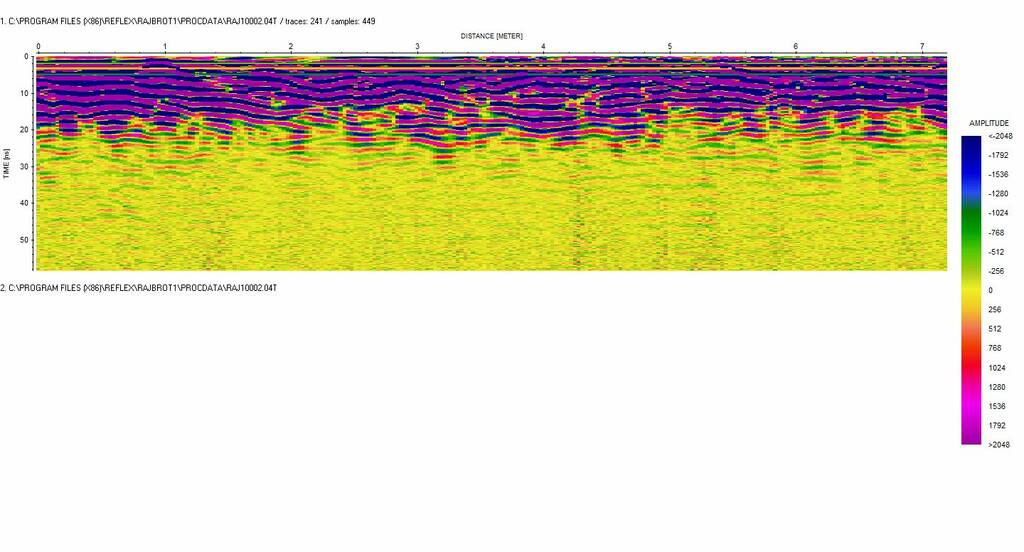
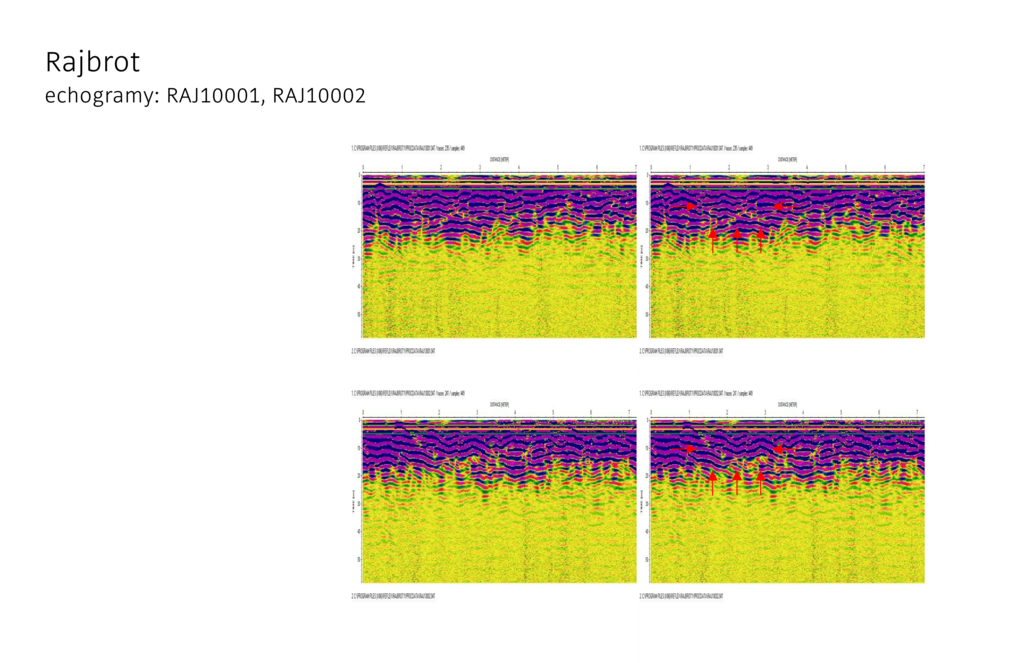
IDENTIFICATION OF THE GRAVE BASED ON NON INVASIVE RESEARCH
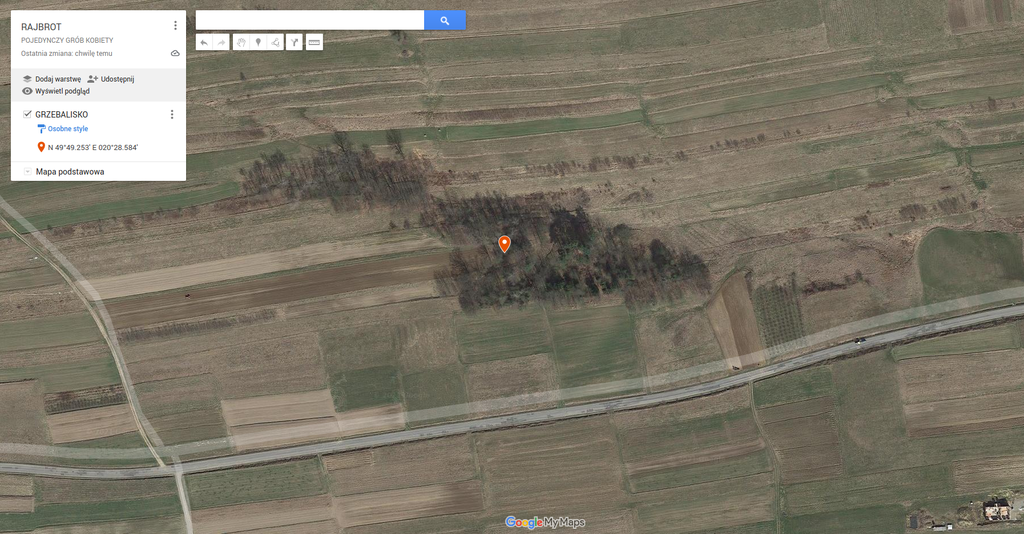
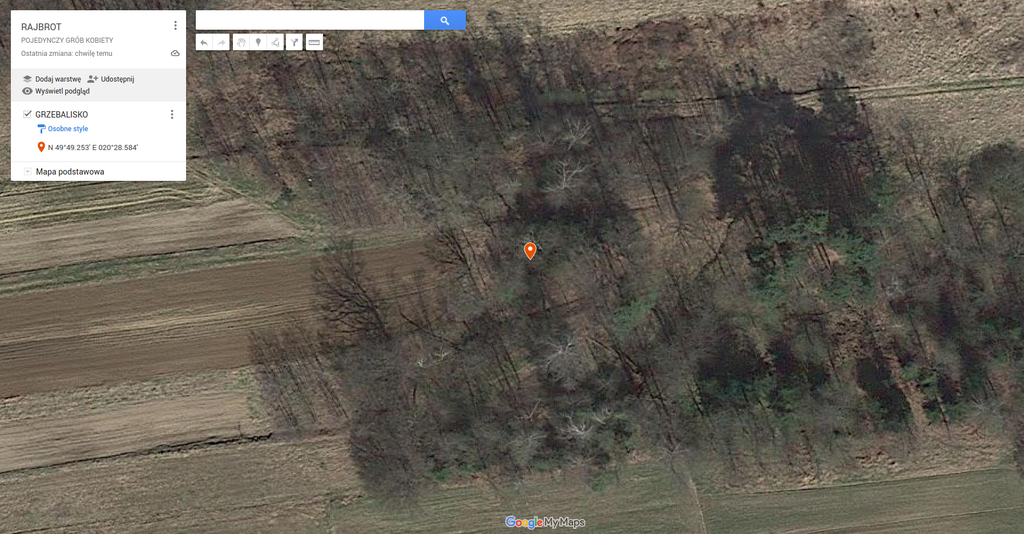
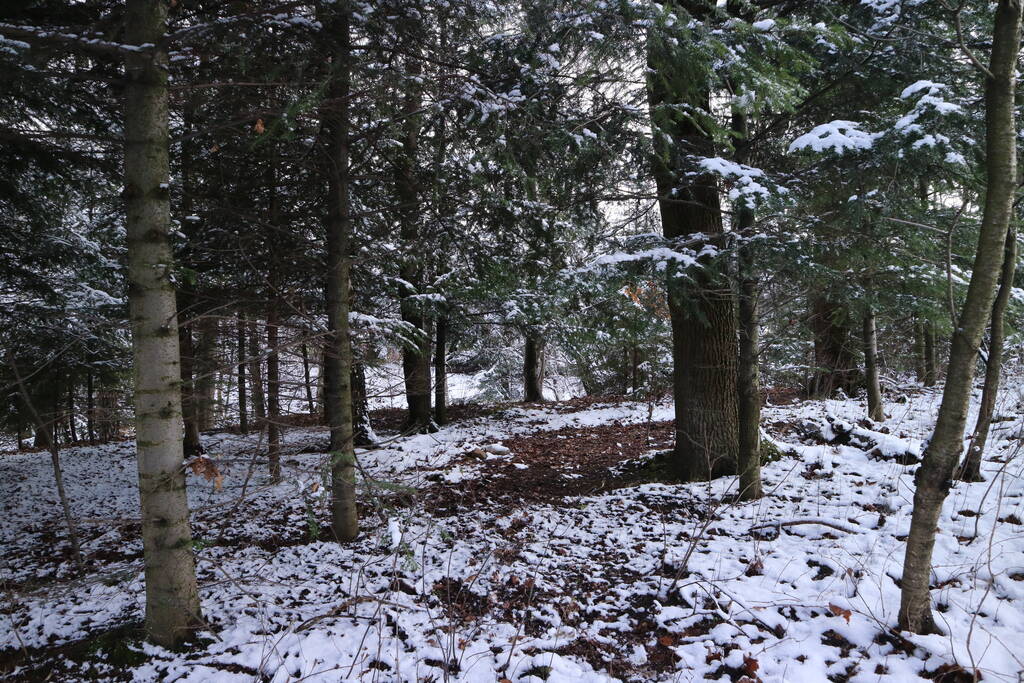
On April 6, 2021, an on-site inspection was carried out in a place precisely indicated as a single grave of a young woman (GPS: N 49 ° 49.253 ‘E 020 ° 28.584’).
The relief model (LiDAR) is not helpful in this case.
No aerial photography query has been conducted for this area.
 rajbrot fotografia satelitarna 1a
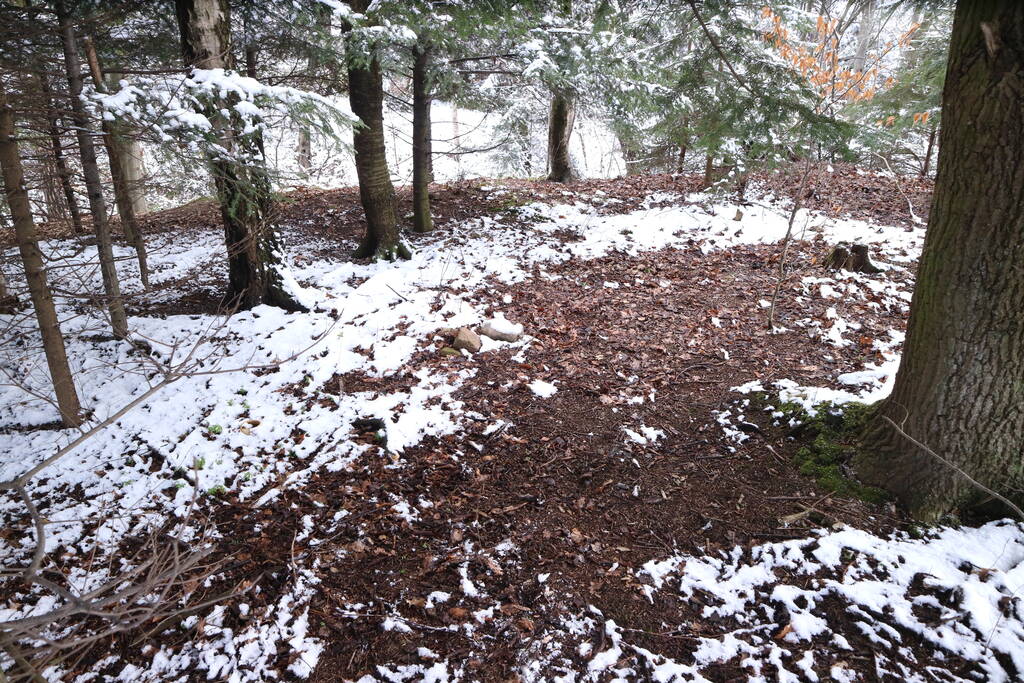 rajbrot fotografia 1 lokalizacji
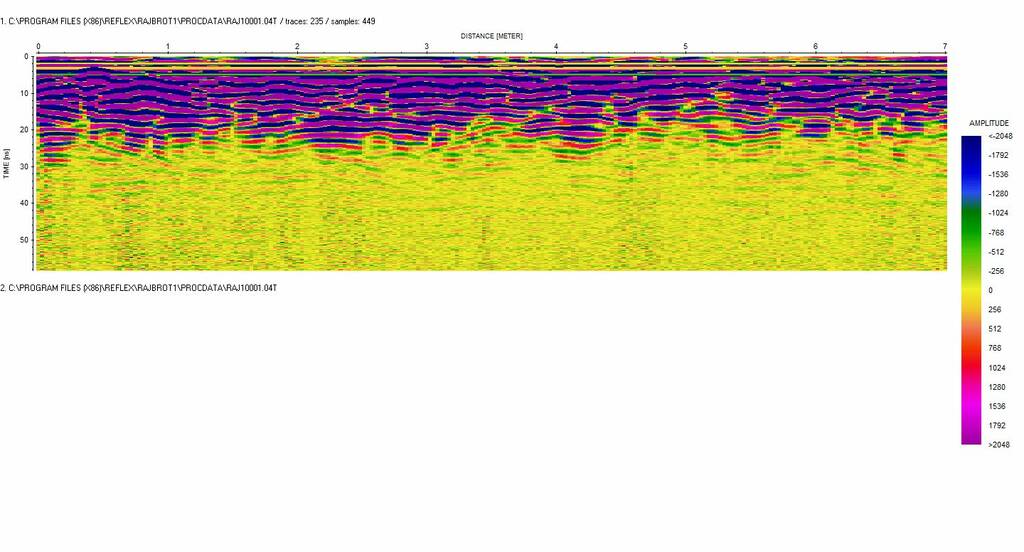 Rajbrot RAJ10001
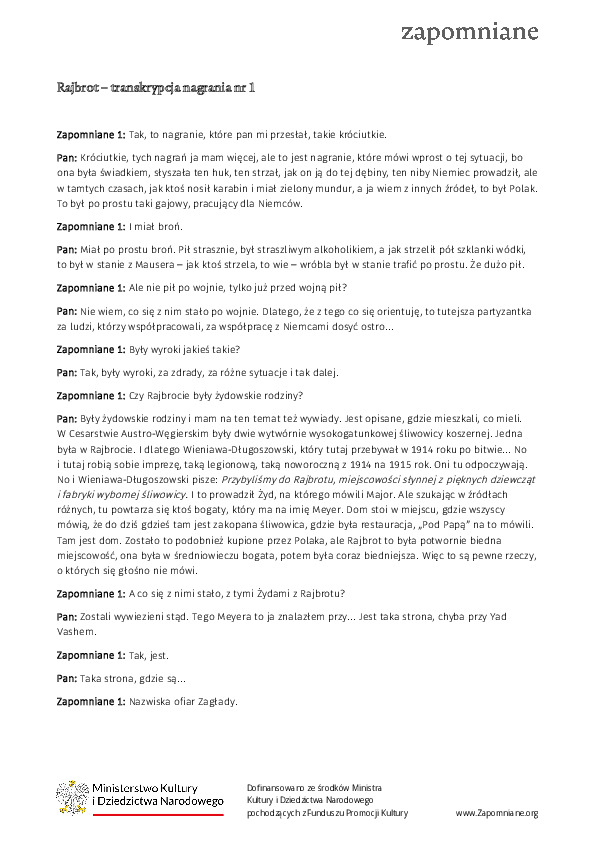
Transkrypcje
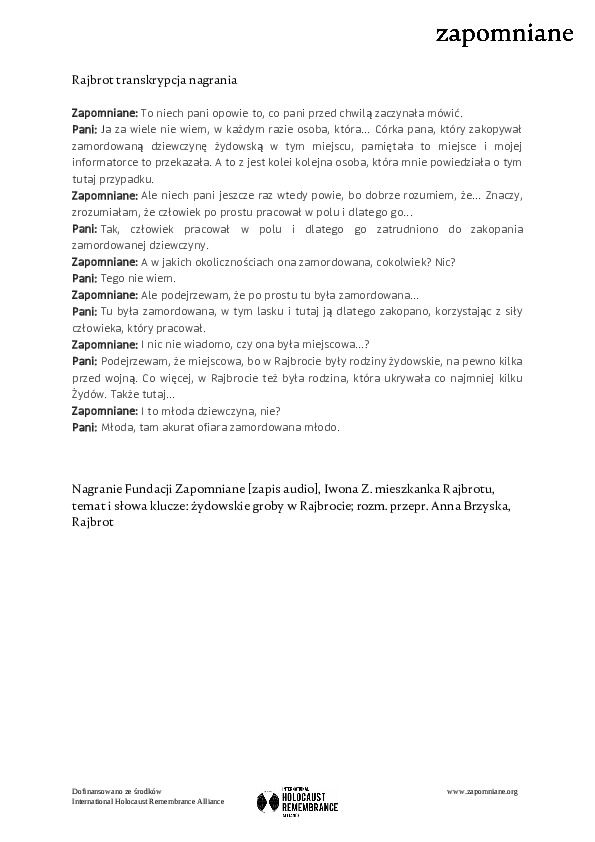 Rajbrot transkrypcja nagrania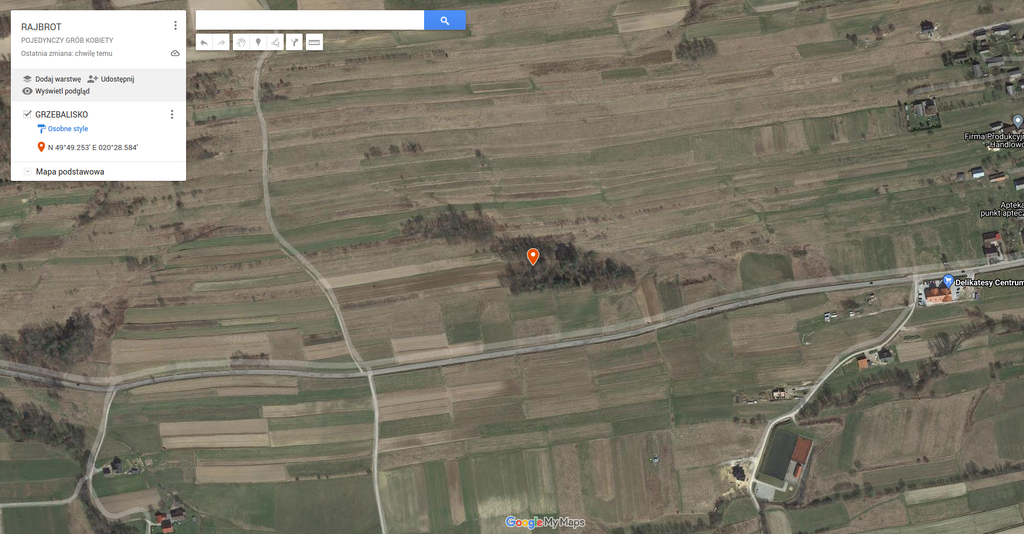

Contact and cooperation
We are still looking for information on the identity of the victims and the location of Jewish graves in Rajbrot. If you know something more, write to us at the following address: fundacjazapomniane@gmail.com.
Bibliography
Recording of the Zapomniane Foundation (audio file), Iwona Z. resident of Rajbrot, subject and keywords: Jewish graves in Rajbrot; exp. Anna Brzyska, Rajbrot, April 6, 2021.
Recording of the Zapomniane Foundation (audio file), resident of Rajbrot, subject and keywords: Jewish graves in Rajbrot; exp. Agnieszka Nieradko, Rajbrot, September 3, 2024.
Krzyzanowski Ł. 2009 (author’s archive)
We have collected the materials about this village thanks to the funding provided by the International Holocaust Remembrance Alliance as part of the project “The rural Holocaust. Collecting and safeguarding the never recorded testimonies 100 forgotten Jewish graves 2021-2022” and also thanks to the support of the Embassy of the Federal Republic of Germany in Warsaw.