Turze Pole
Borough: Haczów, District: brzozowski, Voivodeship: podkarpackieType of place
A private plot.Information about the crime
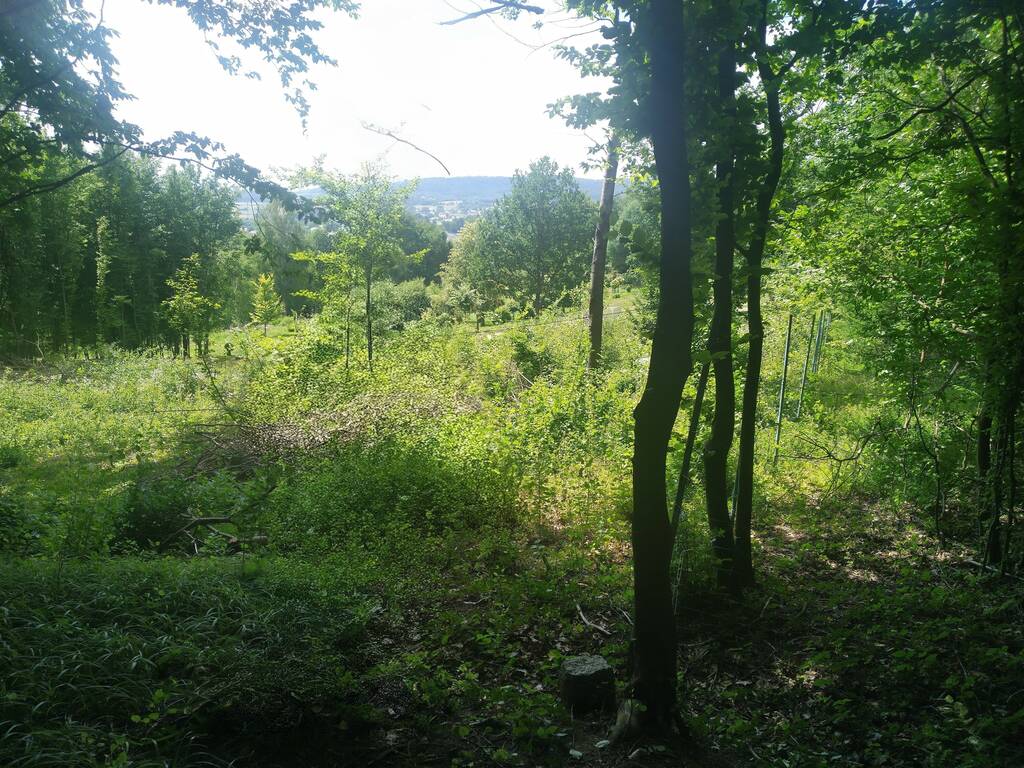
In the summer of 2022, we conducted a site inspection of the burial place of a Jewish family from Brzozów: Szymon Dyck, his wife, and their minor daughter. Brzozów. Before the war, Szymon Dyck and his brothers were involved in poultry trading, hence the nickname “Kogut” (Rooster), by which they were also known. The names of Szymon Dyck and other members of this family appear on the list of Holocaust victims in the Memorial Book of Jews from Brzozów. Ms Krystyna Wojtuń from Turze Pole collected written accounts from people who remembered the Dyck/Kogut family and knew the circumstances of their deaths:
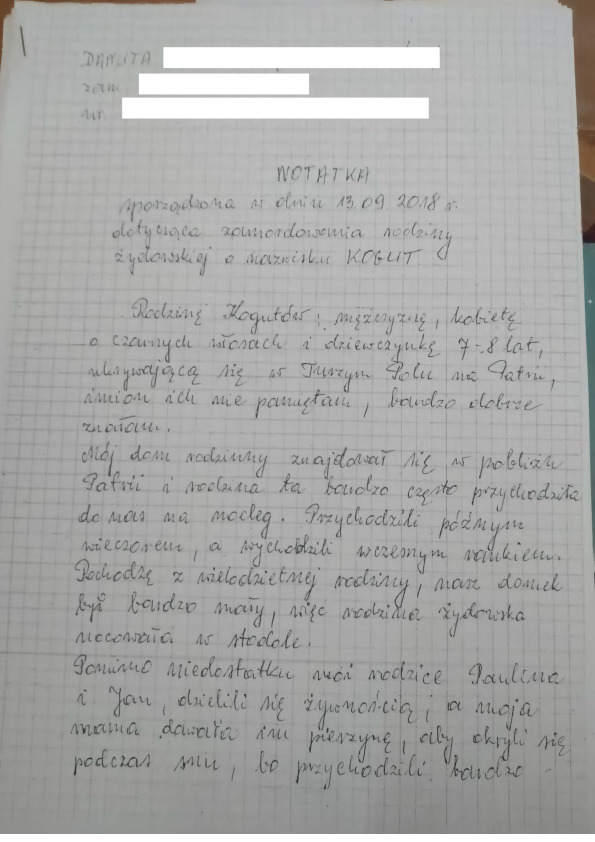
Danuta W. (b. August 30, 1931):
“The Kogut family – a man, a woman with black hair, and a girl about 7 or 8 years old – were hiding in Turze Pole at a place called ‘Patria.’ I don’t remember their names, but I knew them very well. My family home was near Patria, and this family often came to stay with us overnight. They would come late in the evening and leave early in the morning. […] The Jewish family stayed overnight in the barn. Even though we didn’t have much, my parents shared food with them, and my mother gave them a quilt to cover themselves while sleeping, as they came very sad and cold. I felt very sad and sorry for that little girl, so I took her home and we slept together on the floor. don’t remember the dates, but when I learned that a resident of Humniska had betrayed the Kogut family and they were murdered, I felt heartbroken, because I had grown attached to that girl. After the war, my parents, my five siblings and I often visited their grave, which is located on the edge of our field.” (note dated 13 September 2018)
Helena P. (b. 2 February 1928):
“The Kogut family from Brzozów survived the mass execution of Brzozów’s Jews carried out by the German occupiers in the summer of 1942. One day in August, I witnessed the deportation of our distant neighbours to Rymanów, and then further on, to an execution site unknown to me. For their last journey, as it turned out, my mother gave them cakes baked on a kitchen tray. That night, I couldn’t fall asleep from grief.
I knew, as did my friends from the neighborhood, that the Kogut family was hiding in the forest on Patria in Turze Pole, probably in August 1942. Later, I also learned that Kogut had built a hut in the forest, in a pit left after sand excavation, where he lived with his wife and child. They lived in terrible conditions, but the villagers did not refuse them help, especially those living near Patria. I knew that Paulina P., who lived not far from us, would leave a container of milk by the barn after the evening milking for the Kogut family.
I do not remember when the Kogut family was shot, but I know they were murdered and left in the pit where they had been hiding. After the war, I married Stanisław, the eldest son of Paulina and Jan P. From him I learned that the P. family, though possessing very little and risking their lives, offered the Kogut family overnight shelter in their barn, gave them shoes, and that the Koguts’ child often slept in the house with the youngest of their six children, a daughter named Danuta.” (note dated September 14, 2018)
Roman C. (born 1 January 1932):
“After the spring massacre in the forest, in the summer of 1924, a Jew named Kogut came to my parents asking for food for himself and his family. […] The Kogut family was probably betrayed by a resident of Humniska and shot in Patria in early winter 1942 (there was no snow).” (note dated September 13, 2018)
Anna P. (born 23 March 1928):
“I remember very well a Jew named Kogut, who began coming to our home in the summer of 1942. He was very neglected, unshaven, and always had tears in his eyes. He knew that my father was a forester and that Germans were often present at our house, yet despite this he came and asked for help. My mother, Eleonora, baked proziaki flatbreads and cooked rice, which she shared with those in need, helping them in every way she could. She provided milk for the family, clothing, and a blanket for sleeping, risking her own life and the lives of our family, as Germans could come at any time due to my father’s profession. He came to our home until late autumn. It was likely in December 1942 that we learned the Kogut family had been betrayed by a resident of Humniska and murdered by the occupiers. My future husband, Aleksander P. (born 28 January 1926), and his cousin Eugeniusz told me that after the execution they went to the site and saw naked bodies in the grave, each with gunshot wounds to the back of the head. Seeing that younger children were coming to the grave to look at this cruel sight, they covered the bodies with earth. While my husband was alive, he preserved the memory of these unfortunate people, often taking me and our children to the grave and telling us about those cruel times.” (note dated September 13, 2018)
In January 2019, Roman and Krystyna Wojtuń funded a monument commemorating the Jewish Dyck/Kogut family. The exact location of the burial site of the victims still needs to be determined.
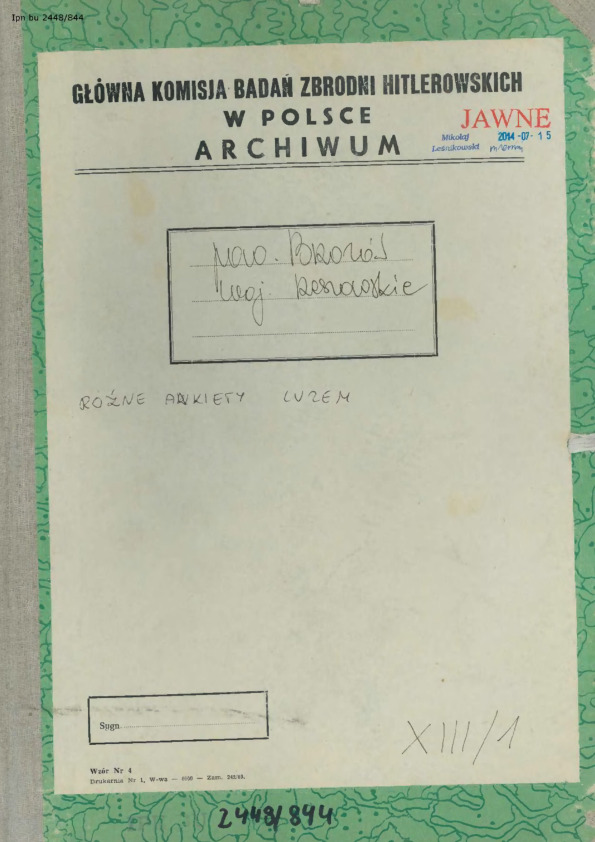
According to a survey conducted by the Chief Commission for the Examination of German Crimes in Poland from Brzozów district, Szymon Dyck and his family were murdered in 1943 “in the forest near the school.” Four people were said to have died that day – two men, a woman and a child. The burial site was indicated as the cemetery in Humniska. (IPN Bu 2448/844 and 845)
 Turze Pole fotografia lokalizacji
Sources
 Turze Pole Ankiety-GKBZH-w-Polsce_1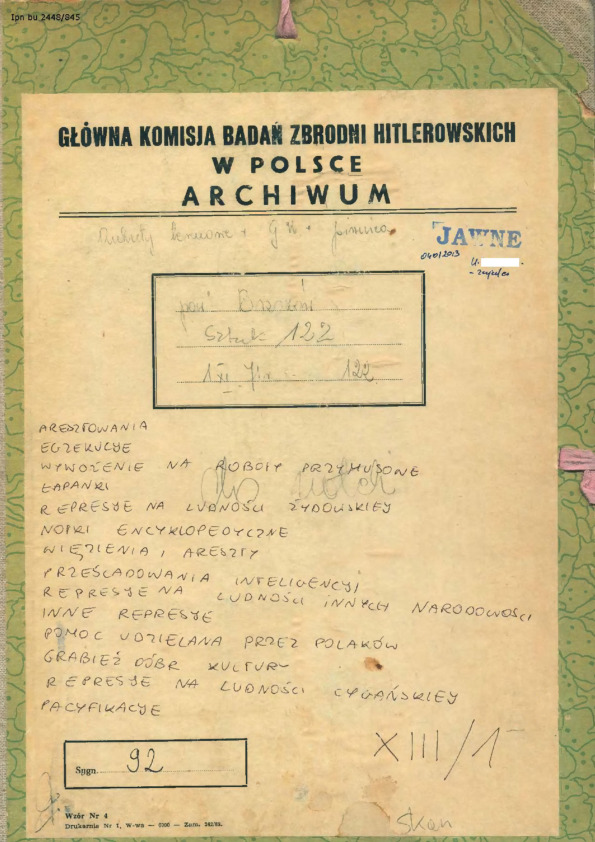
Contact and cooperation
We are still looking for information on the identity of the victims and the location of Jewish graves in Turze Pole. If you know something more, write to us at the following address: kontakt@zapomniane.org.
Bibliography
The Memorial Book of the Jews of Brzozów (link)
IPN Bu 2448/844, The Chief Commission for the Examination of German Crimes in Poland, Brzozów district
IPN Bu 2448/845, The Chief Commission for the Examination of German Crimes in Poland, Brzozów district
Accounts of residents of Haczów collected by Krystyna Wojtuń in 2018 (archive of the Zapomniane Foundation)
The materials published on this website were developed, digitized, and made available thanks to funding from the Minister of Culture and National Heritage through the Culture Promotion Fund, as well as support from the Embassy of the Federal Republic of Germany in Warsaw, which also enabled the creation of the English-language version of the website.