Turobin
Borough: Turobin, District: biłgorajski, Voivodeship: lubelskieType of place
Jewish cemetery in Turobin.Information about the crime
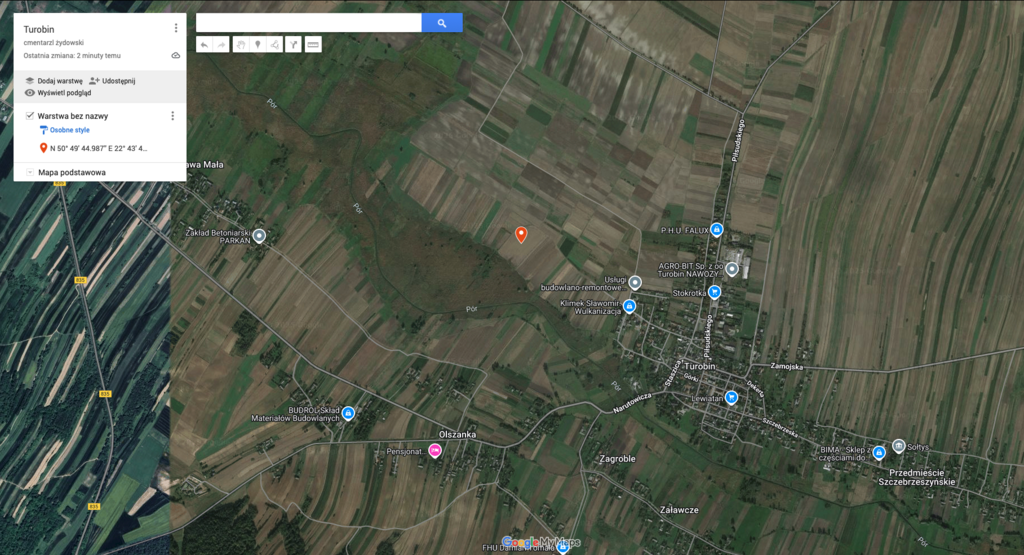
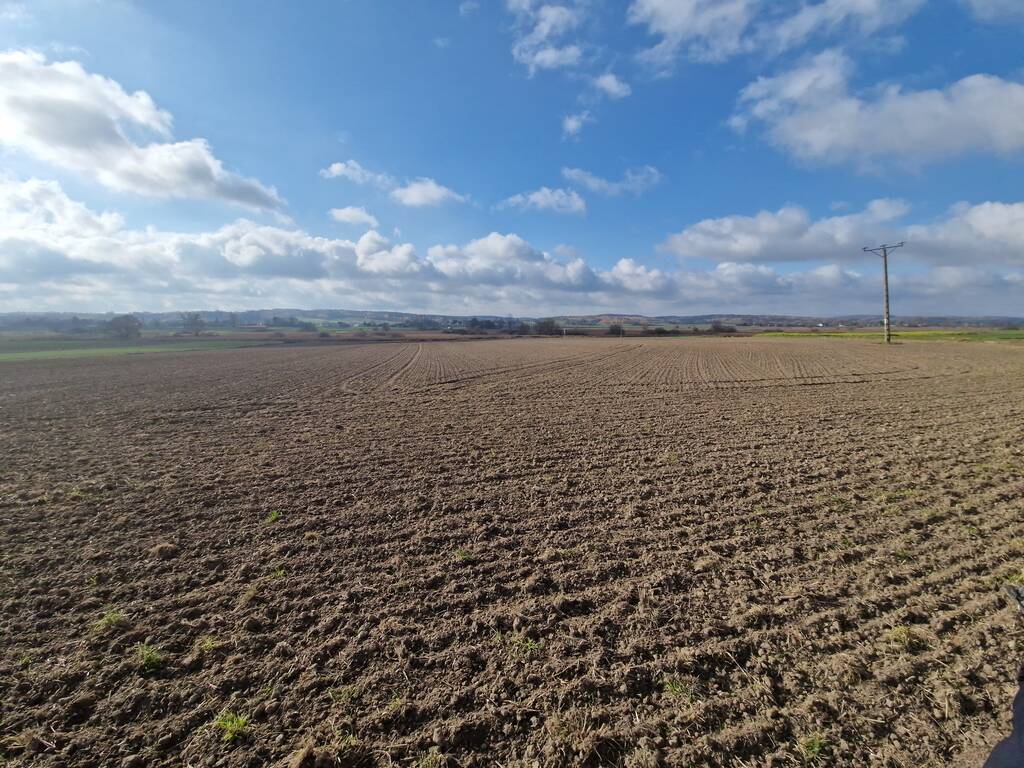
On 4 November 2024, we conducted a site inspection of the Jewish cemetery in Turobin. The necropolis is currently privately owned and has been converted into arable land. No above-ground traces of the cemetery have survived. During the Holocaust, the cemetery served as a burial site for the murdered Jewish inhabitants of the town.
According to the Register of Killing Sites and Crimes for the former zamojskie voivodeship, the following events took place in Turobin:
- In April 1942, during the deportation of Jews to extermination camps, the Germans shot 150 people.
- 1942 – SS officers confined Jews captured in a roundup in a brick building and threw grenades inside, killing 112 men. On the same day, the same perpetrators killed three Jewish women and five children in the courtyard. The victims were buried in the local Jewish cemetery. (The Register of Killing Sites and Crimes… Warsaw, 1994)
Bolesław B. (son of Jacenty):
“Before the war and during the occupation, I lived in Turobin, at that time in the Krasnystaw district, and I was a judge of the District Court. […] It was in 1942, in the autumn, when I was informed that Germans had arrived in Turobin and were rounding up Jews. Soon after, three adult Jewish women with two children – one was an infant, carried in their arms, the other was about five or six years old – came to my apartment and asked me if they could stay there, because the Germans were rounding up Jews in Turobin. I knew these people, they were members of the Brawerman family, consisting of a mother, daughter, daughter-in-law and children – I do not remember their names. I allowed the Jewish women to stay in my apartment. […] I advised the Jewish women to hide with their children in a garden behind the house. The women left the building through the door leading into the garden. At the same time, I heard a knock on the front door. I opened the door and saw a German who, speaking Polish, asked me if there were any Jews in the building. […] The German went up the stairs to the attic. The aforementioned Jewish women and children were standing in the corridor outside Z.’s apartment. The German led them outside the building. Through the kitchen window, I saw him line them up close together and then push them down so that they fell to the ground. The Jewish women wailed and begged the German to let them go, folding their hands. The German fired several times at the Jewish women and children lying on the ground. He then turned back toward the building and was already in the corridor when he heard a child crying. The German went outside again, approached the people lying on the ground and shot the tiny, crying child. […] That German, who spoke Polish very well, said that people of the Judenrat would come and remove the bodies. I saw the Jewish individuals he had killed in the yard of the court building – three adult women, aged approximately 30, 35, and 65, and two Jewish children. One of these women had her skull shattered by a gunshot. That day, Jews arrived and took away the five bodies, which were buried in the Jewish cemetery in Turobin. […] On that same day, the Germans Klemm and Engels came to Turobin by automobile from Izbica, accompanied by a driver. The three of them killed around 120 Jews in Turobin that day. The majority of the Jews were gathered in two brick buildings and were killed there with grenades by the Germans. I was near those buildings, but I did not go inside, as I felt physically ill at the sight of the corpses, but I saw a lot of blood flowing out of those buildings. On the following day, I saw the surviving Jews carrying the bodies wrapped in sheets, arranging a mass burial of the killed Jews at the local cemetery. The Jews cried and lamented. In the autumn of 1943, the Jews of Turobin were marched on foot to Izbica near Krasnystaw, and then deported to the extermination camp in Bełżec, where they were killed by the Germans.” (IPN Lu 431/109 vol. 1)
In the archives of Yad Vashem, there is a testimony about Nechama Braverman, born in 1922, a resident of Turobin, who was murdered there in 1942.
Bolesław B. (son of Adam):
“I remember an incident that took place in the autumn of 1943 […] That day in Turobin, I heard gunshots and grenade explosions. […] People said that Engels and Klemm carried out a pogrom against the Jewish population in Turobin, which involved the mass killing of Jews in their homes and on the streets, as well as the killing of a large group of Jews gathered in two houses with grenades. The Germans first executed the Judenrat, the Jewish council, in the hallway of a tenement belonging to a Jew called Wulw. In two buildings, around 50–60 Jewish people were killed with grenades. Other Jews were killed with handguns or small arms. On that day, Engels and Klemm killed around 150 Jews – including children, women and men. I remember one of the murdered Jews, Herszek Jakubson, aged around 30, a merchant. I saw the Jews who had been killed, including those killed with grenades. It was a terrible sight, as their bodies were torn apart. The murdered Jews were buried in the Jewish cemetery in Turobin, known as the kirkut.” (IPN Lu 431/109, vol. 1)
Edward M.:
“On that day, Engels and Klemm ran around like madmen, searching for Jews, killing around 170 in total. There were no exceptions; they killed children, women and men. In the afternoon, as I stood beside my house, I saw Engels and Klemm walking toward a Jewish house about 20 meters away. […] I heard gunshots. […] My neighbor J. and I went to the Jewish house mentioned earlier. There, I saw seven Jewish people: two men, one of whom was lying in bed, four women, and a child about one year old. They were two families I knew, though I no longer remember their names. […] In the evening of that day, following German orders, Stanisław B. and the surviving Jews buried the murdered Jews in the Jewish cemetery.” (IPN Lu 431/109, vol. 1)
Jan W.:
“About 100 metres away, I saw a Jewish woman kneeling on the pavement and a German standing before her. She extended her arms as if to cling to his legs; he pushed her away with the gun barrel and shot her once. The woman fell to the pavement, convulsing, but did not get up. […] The murdered Jewish woman was called Szterenfeld, I don’t remember her first name; she was about 60 years old and was the wife of Zysl Szterenfeld, the owner of a small groat mill. He was processing millet and buckwheat into groats. At that moment, an unknown Jewish woman ran out of a nearby house, wailing and shouting. At the same time, the German saw me and aimed his rifle at me, intending to shoot. Seeing this, I immediately hid behind Chil Kipfer’s house. At the same time, I heard a shot and the whistling of a bullet flying past. Right after that, I heard a second shot, and the cries of the Jewish woman ceased. I believe that she was killed. I went to my house, and for about three hours, I could hear shots echoing throughout Turobin. […] On that day, Engels and Klimm organised a pogrom against the Jewish population, killing Jews in the streets and in their homes, and even throwing grenades into two houses where Jews were gathered. One house belonged to Wulf Liberbaum and the other to Giwerc, and I saw Jews killed with grenades. The bodies were torn apart and blood was flowing in streams. At least 40 Jews may have been killed in Liberbaum’s house, and about 20 in Giwerc’s house. Among the victims were Jewish children, women, and men.” (IPN Lu 431/109 vol. 1)
Bolesław M.:
“[…] in the courthouse yard, I saw a Jewish woman, the wife of Gierszon Brawerman, struggling with a German. The German pushed her away and then shot her in the head with a pistol. Afterwards, the German shot Gierszon Brawerman’s daughter, who was married to Fuks, and killed her. She was about 22 years old. She was holding a child about one year old in her arms. The German shot and killed that child. […] The Germans herded the Jews into the house of a Jew named Wulf. There may have been about 30 of them. The Germans entered the house, and soon gunfire was heard. Among the people killed in that house was a Jew named Herszek Jakubson.” (IPN Lu 431/109 vol. 1)
Franciszek S.:
“The mayor of the borough, F., ordered me to take care of burying the dead. In the house belonging to Wulw Liberbaum, which currently houses the civil militia station, we found about 10 bodies in one room downstairs, including about 3 women, and upstairs in the same house, on the table, there were 2 girls, Liberbaum’s granddaughters, aged about 3 and 5. They had been killed. Additionally, in one of the houses in the market square, we found about 10 adult bodies. Nearly all the Jews killed that day were inside their homes. […] The bodies were transported throughout the night to the local Jewish cemetery, where they were buried in several mass graves.” (IPN Gk 175/84)
Bolesław B. (son of Jacenty):
“[The Germans] locked 30 men in one apartment and about 20 people in Wulf Liberbaum’s apartment, […] one of the Gestapo officers shot Wulf Liberbaum, his wife, his daughter, and two young granddaughters, aged approximately 4 or 5. The Jews, realizing that the Germans were killing people, fled outside Turobin or hid in Polish houses. That day, in the courthouse building, a woman named Brawerman, around 60 years old, her daughter-in-law, about 30, her daughter, about 25, were hiding, along with two small children, one a few months old, the other around 1 to 2 years old. […] On that day, the Germans murdered about 120 Jews, including about 20 children.” (IPN Gk 175/84)
Janusz B.:
“At around 11 o’clock, shots were heard in the town, and the Jewish population, in panic, began fleeing in all directions. As it turned out, the Germans had organised a hunt for the unsuspecting Jewish population. Every Jew they encountered, whether man, woman, or child, was killed. They went through the apartments occupied by Jews one by one, killing everyone inside. I saw with my own eyes how a Gestapo officer, either Engels or Klemm, entered the courthouse in Turobin with a rifle in his hand and led out to the courthouse yard people I personally knew: the wife, daughter, and daughter-in-law and two small children of the butcher Brawerman from Turobin. Despite their begging, crying, and offering money for their lives, he began to line them up on the ground and shoot them with his rifle. The children were shot with a revolver. At the same time, the other Gestapo officers were murdering other Jews. […] At the house of a man named Wulf, the perpetrators gathered around 30 Jews, both men and women, into one room on the first floor, where Engels and Klimm killed them using rifles and grenades. Braun was shooting with a revolver, while the driver was hacking the unfortunate victims with an axe. Soon, all the victims were lying on the floor covered in blood. A survivor later told me he had saved himself by crawling under the bodies, but there was so much blood streaming that it almost drowned him. On that day, the perpetrators murdered approximately 200 people. In the evening, by their orders, carts designated by the mayor transported the bodies of the victims to the Jewish cemetery. The cries and moans of the surviving family members, who had lost their loved ones under such terrible circumstances, could be heard all night long.” (IPN Lu 503/97)
IDENTIFICATION OF THE GRAVE BASED ON NON INVASIVE RESEARCH
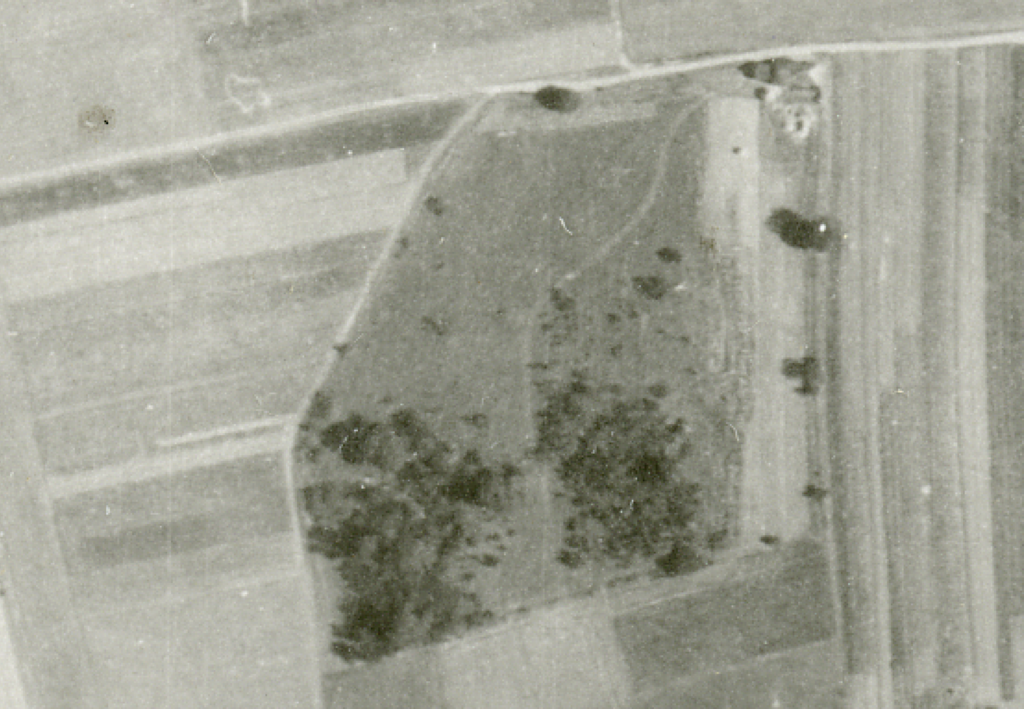
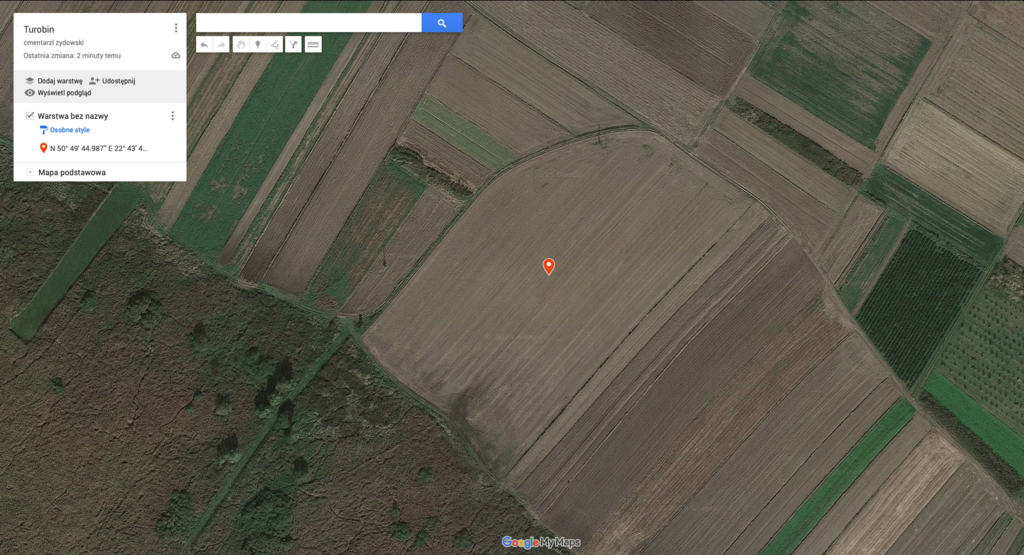
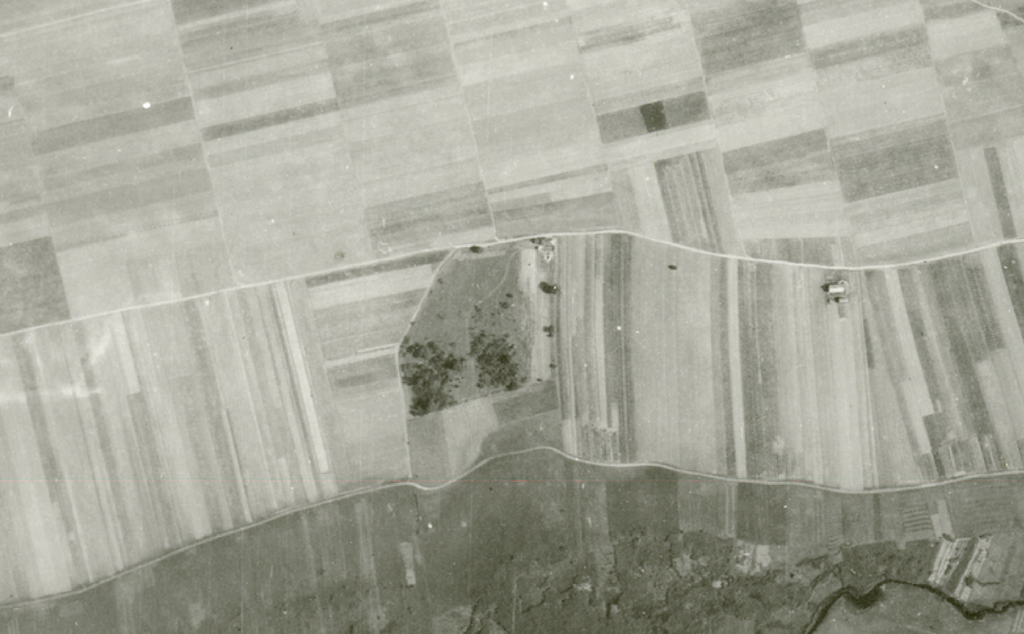
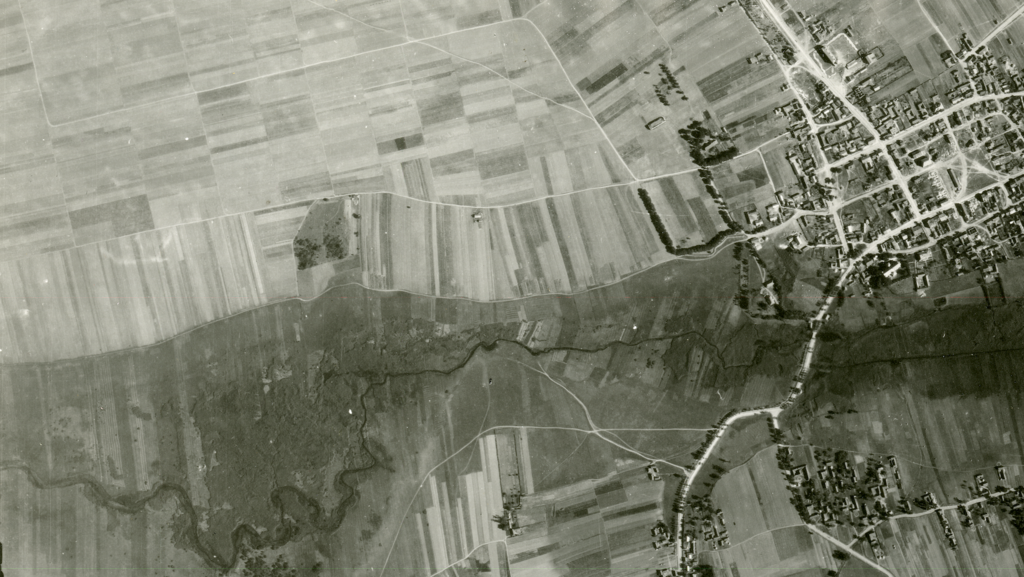
As a result of an aerial photography query, a photo with the signature GX12195-A SD frame 323, taken on 18 September 1944, was obtained. The aerial photograph covers the area of the Jewish cemetery (GPS: N 50° 49′ 44.987” E 22° 43′ 48.151”), which is currently a cultivated field. The image clearly shows the cemetery grounds along with its historical boundaries. In the northeast corner, a building is visible, probably a funeral home with an adjoining smaller building on the western side. Furthermore, on the southern side of the building, ground disturbances are visible, as well as shadows that indicate the presence of smaller objects in this area.
Leading from the funeral home building is a path shaped like an S. In the southern part of the cemetery, there are older trees, and their dark gray shade is clearly visible. Individual trees are also planted along the eastern boundary. This section of the cemetery was probably plowed, as indicated by the light gray, regular, rectangular areas in the soil. A dirt road runs along the northern boundary of the cemetery, and a single tree growing on the very edge of the cemetery is also visible. The ground in this area has been disturbed in the past, which is clearly visible in the photograph. A light gray strip running along the east-west axis, just beneath a single tree on the northern edge of the cemetery, may indicate a filled-in burial site of victims. This location is accessible from the west, north and east, where the main entrance was probably located.
The LiDAR survey is not possible in this case due to the complete removal of all traces of the cemetery.
Non-invasive research using geophysical tools are recommended for further investigation of this area.
 Turobin fotografia satelitarna 1a
 Turobin fotografia lotnicza 1a
 Turobin fotografia lokalizacji AN
Sources
 Turobin Akta karnej pomocy prawnej dot. przesłuchania w charakterze świadków_ Edward Steindl i inni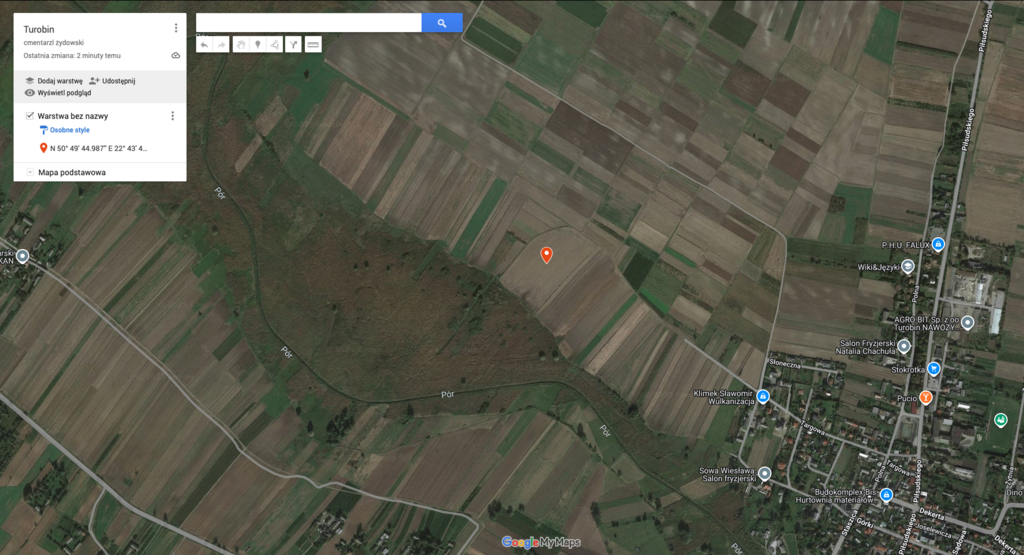
Contact and cooperation
We are still looking for information on the identity of the victims and the location of Jewish graves in Turobin. If you know something more, write to us at the following address: kontakt@zapomniane.org.
Bibliography
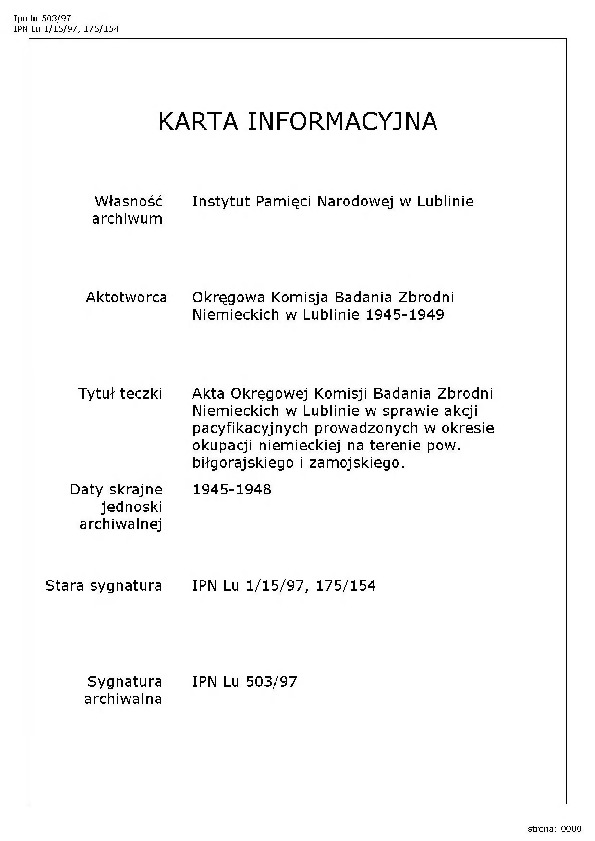
IPN Lu 503/97, files of The Regional Commission for the Examination of German Crimes in Lublin regarding the pacification operations carried out during the German occupation in the biłgorajski and zamojski districts, pp. 1, 65-73
IPN Lu 431/109 vol. 1, criminal legal assistance files concerning the interrogation of witnesses: Edward Steindl and others in the case of crimes committed in 1941-1943 by Gestapo officers residing in Izbica – SS-Hauptscharführer named: Kurt Engels and SS-Unterscharführer Ludwik Klemm alias Ludwig Jantz pp. 1, 36–40, 57–70
IPN Gk 175/84, The murder of approximately one hundred Jews in Turobin (witness interrogation records, correspondence)
The materials published on this website were developed, digitized, and made available thanks to funding from the Minister of Culture and National Heritage through the Culture Promotion Fund, as well as support from the Embassy of the Federal Republic of Germany in Warsaw, which also enabled the creation of the English-language version of the website.