Mielec
Borough: Mielec, District: mielecki, Voivodeship: podkarpackieType of place
The so-called Berdechowski Forest.Information about the crime
In October 1939, the State Aviation Works in Mielec, transformed by the German occupation authorities into a forced labour camp for Jews, became part of the German aviation concern Ernst Heinkel Flugzeugwerk from Rostock and operated during the war under the name Flugzeugwerk Mielec. The number of victims of the camp is estimated at several hundred (800–900) people. However, the location of the mass graves of the victims is still unknown. Executions and burials took place in the Berdechowski forest. Currently, it is a forested area between the northern part of the former WSK Mielec facilities (now SSE EURO-PARK) and the airport. During the occupation, the Berdechowski forest was larger and included, among other areas, the strip of land along the present-day COP (Central Industrial District) Street, adjacent to the SSE facilities. “The Berdechowski forest was located north of what was then the northern gate of the plant, not far from the horticultural farm, which had been taken over by the Germans.” (Krempa, 2022)
Numerous testimonies from witnesses and survivors have been preserved, indicating Berdechowski forest as the site of executions and mass burials.
Gimpel Spielman, aged 50, a merchant from Mielec and former camp prisoner (testimony from December 4, 1946): “[…] Initially, the average number of prisoners was 1,500, and later it reached approximately 3,000. From 1943, there were also around 400 women here. There was one child aged 3 in the camp, but not for long, as Drozd shot him soon. […] If someone walked bent over during the march to work, Stein [the camp commandant] would make a note of it, and the very next day the Werkschutze [camp guards] would take them to Berdechów, where the Gestapo and Werkschutze executed them. […] Zimmermann [one of the Gestapo officers] would often come to the camp, selecting a certain number of prisoners at his discretion, and taking them to Berdechów, where he would execute them. […] In 1942, a typhus epidemic broke out in the camp, due to starvation, unsanitary conditions, and the camp’s rations. The sick were taken away to be shot. Few people died of natural causes, as sick prisoners were usually taken to Berdechów for execution. Even those who recovered were taken away to be shot. During the epidemic, approximately 300 people fell ill. During the camp’s existence, approximately 900 people were executed. The site of the executions was Berdechów, more precisely the area near the forest located next to the airport in Mielec.” (IPN Rz 1/17)
Henryk Noworyta, telemechanic, employed at State Aviation Works (testimony from December 5, 1946): “The place of executions was in Berdechów, in the Chorzelów hamlet, about 100 meters from the factory. Shootings took place in the forest in Berdechów. After burying the bodies of the executed, the sites were leveled. In Berdechów, not only Jewish people were shot, but also Poles. It is possible that people of other nationalities were also executed there. People who were unfit for work and those detained by the Gestapo in the town were taken to be executed. Executions were carried out frequently, particularly of Jewish people, and not just once, but twice a week. […] No barracks from the Jewish camp remain, as they were dismantled and sold. Only an empty square remained after the camp. The closed camp was located on the premises of the aircraft factory, but was fenced with barbed wire and electrified. The average number of Polish prisoners in this camp was about 20, while the Jewish population exceeded 200.” (IPN Rz 1/17)
Schulim Hollender, born in 1906 in Trzciana near Mielec, a former prisoner of the camp, testified on 26 July 1946 before the Regional Commission for the Examination of German Crimes in Tarnów: “During my stay in this camp, from March 9, 1942, to June 1944, over 900 people were shot here.” (IPN Rz 1/17)
Zygmunt Reich: “The Berdechowski forest near our factory was a place of executions, and our people dug mass graves there. “Berdechów” meant executions in our camp, and the Germans made no secret of it. If someone fell ill and was sent to the “infirmary,” and the illness proved serious, they generally never returned to the camp, as they were immediately sent from there to Berdechów.” (AŻIH 301/1428)
Berta Lichtig: […] “Those suffering from typhus were killed, and Zimmermann’s amusements claimed an enormous number of victims. Later, Jews with Aryan papers were also caught, and Berdechowski forest claimed them as well.” (AŻIH 301/1029)
The testimony of Aleksander Studziński, who worked as a labourer at the airport, in the Communication Equipment Factory in Mielec, may be particularly important for future research and locating burial sites: “Several times, from a distance of about 50 metres, I saw Germans driving Jews out of the camp in groups of up to 17 people, and all of these Jews were shot in the forest by Zimmerman, a Gestapo officer from Mielec. The Jews were escorted to their execution by several camp guards. Zimmermann shot Jews in the back of the head at close range with a handgun. Before the execution, all Jews had to undress and kneel on the ground. The ditches had been dug by Jews who were executed earlier.”
The case files also contain photographs from the site inspection, during which Studziński indicated ‘the location and length of the ditch’ and “demonstrated the position of the prisoners at the execution site before they were shot.” (file No. Ds. 24/67)
According to Andrzej Krempa, some of the graves may have been destroyed after the war.
“The graves in Berdechowski forest are unmarked. Some areas are forested or built over. According to some witnesses, some of the graves are covered with concrete from a runway for jet planes built after the war, stretching along the southern part of the airport (currently COP Street). During modernization work on this runway (see photograph from the site inspection, the runway is marked with a black line along COP Street), in the 1950s, human remains that were uncovered were packed into crates and transported to an unknown location. It is likely that the construction of the railway track (the line crossing the forest on the maps) in modern times disturbed the burial sites. […] After the war, institutions dealing with burial sites determined the number of people buried (800) based on the visible remains of graves. These figures roughly correspond to estimates made based on information about prisoner rotation in the camp and data provided by the Home Army’s industrial intelligence in Mielec about the number of Jews working there. As no exhumations were carried out, the exact number of people buried there is unknown.” (Krempa, 2022)
Sources
 Mielec - obóz żydowski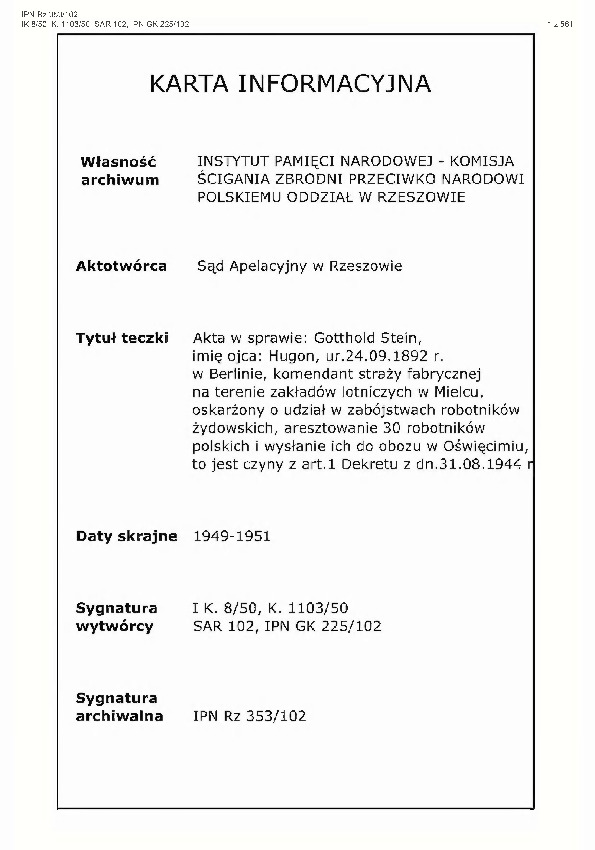
Contact and cooperation
We are still looking for information on the identity of the victims and the location of Jewish graves in Mielec. If you know something more, write to us at the following address: kontakt@zapomniane.org.
Bibliography
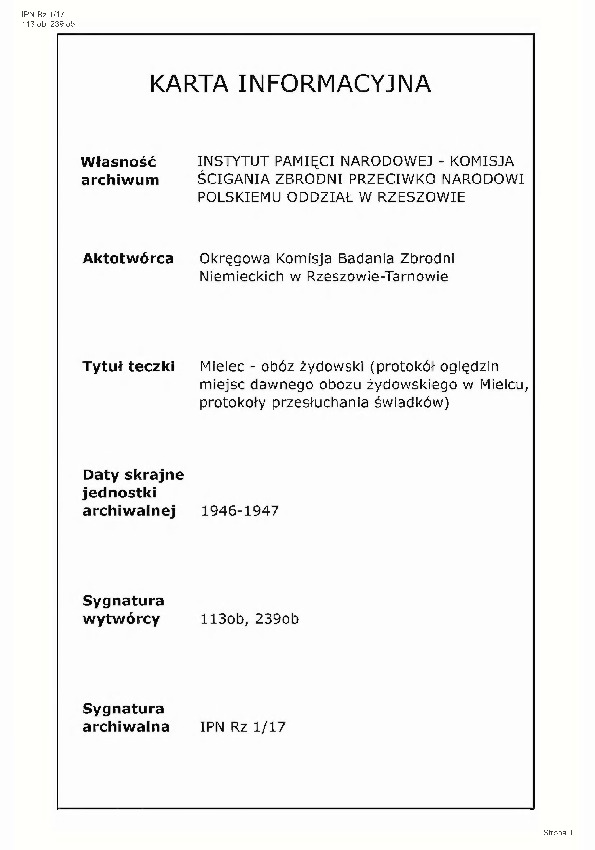
IPN Rz 1/17 Mielec Jewish camp (protocol of inspection of the site of the former Jewish camp in Mielec, witness interview records)
IPN Rz 353/102, files on: Gotthold Stein, father’s name: Hugon, born on 24 September 1892 in Berlin, factory security commander at the aviation works in Mielec, accused of participating in the killings of Jewish workers, arresting 30 Polish workers, and sending them to the Auschwitz camp, i.e., acts under Article 1 of the Decree of 31 August 1944.
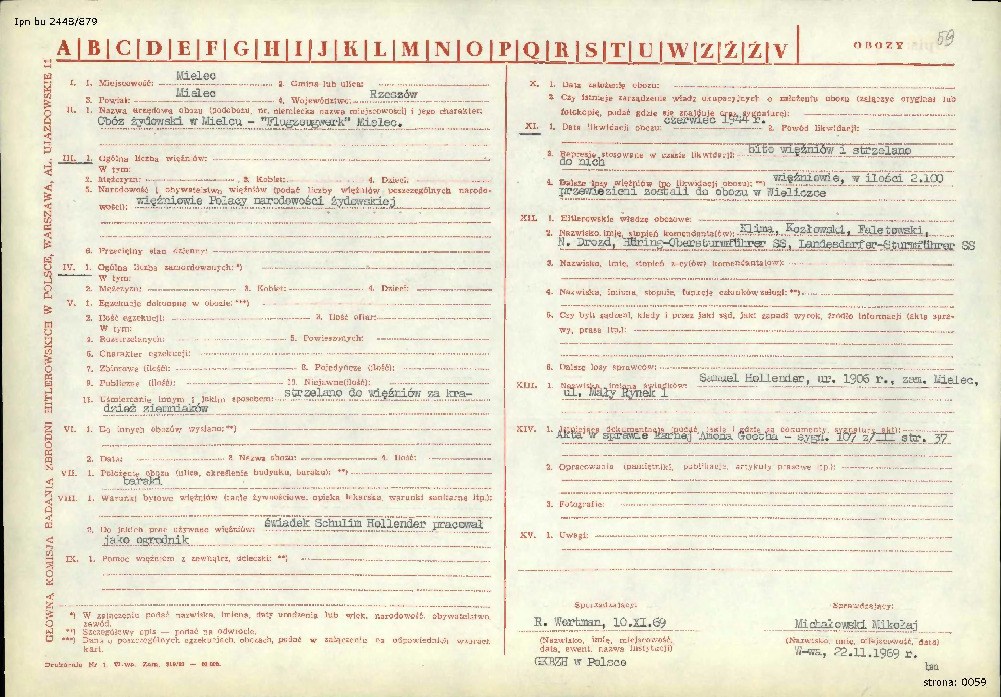
IPN Bu 2448/879 The Chief Commission for the Examination of German Crimes in Poland questionnaires. Mielec district, rzeszowskie voivodeship, pp. 1, 2, 3
Krempa A., Sztetl Mielec. Z historii mieleckich Żydów (The Shtetl of Mielec: From a History of Mielec’s Jews), Mielec 2022 r.
AŻIH 301/1428 Zygmunta Reich’s account
AŻIH 301/1029 Berta Lichtig’s account
The materials published on this website were developed, digitized, and made available thanks to funding from the Minister of Culture and National Heritage through the Culture Promotion Fund, as well as support from the Embassy of the Federal Republic of Germany in Warsaw, which also enabled the creation of the English-language version of the website.