Luzino
Borough: Luzino, District: wejherowski, Voivodeship: pomorskieType of place
Parish cemetery in Luzino.Information about the crime
On May 22, 2024, we conducted a site inspection of the parish cemetery in Luzino and met with employees of the local Cultural Center and representatives of the Stutthof Museum in Sztutowo. The memory of columns of prisoners from the Stutthof concentration camp passing through their town during death marches is still vivid among the local residents.
In the introduction to the second edition of Janina Grabowska’s Marsze śmierci. Ewakuacja piesza więźniów KL Stutthof i jego podobozów 25 stycznia – 3 maja 1945 [Death Marches: The Forced March Evacuation of KL Stutthof and its Subcamps (January 25 – May 3, 1945)], Agnieszka Kłys and PhD Marcin Owsiński write: “The concepts and plans for the evacuation [of prisoners from the Stutthof concentration camp], developed since autumn 1944 under the codename ‘Eva Fall,’ did not clearly and in detail specify the general direction or technical manner of conducting the entire operation. For Third Reich officials, it was just a minor point on the map, but for the prisoners, it became an extreme experience, which they called the Death March. The graves of the victims of these events, as well as traces in the landscape, are still visible today. Equally important is the social memory of these events, passed down through successive generations in Kashubia. Contemporary commemorations and local initiatives show that this remains a very important period in the recent history of Pomerania. […] Alongside the evacuation of the central camp, the evacuation orders also applied to prisoners from the Stutthof special camp and thousands of prisoners who, at the beginning of 1945, were held in its numerous subcamps across Pomerania and East Prussia. Both evacuations claimed approximately 16,500 victims, accounting for a substantial percentage of all Stutthof victims throughout its entire history.” (Grabowska, 2023)
“It has long troubled me that the resting places of murdered Jews are often not properly commemorated, and sometimes even ignored. One such place, where Jewish participants of the KL Stutthof Death March are buried, is the parish cemetery in Luzino. This village served as a resting point for the prisoners. Several residents of Sztutowo died or were murdered there. Catholics were buried in the local cemetery, and the grave is well-maintained. Jewish prisoners were buried under the fence of this cemetery (it is difficult to determine today how many of them are buried there, but they were probably women). There is no confirmation of this in historical sources; this information exists only in the memories of a few people. The grave is not marked in any way, only a slight elevation of the ground is visible beneath the fence. Until recently, a large bush grew there, under which candles were lit. For some time now, it has been gone.”
In the Municipal Cultural Center in Luzino there is a testimony from Anna Drabik, born 1933, whose father buried the body of a Jewish woman in the parish cemetery: “My father said that he buried a Jewish woman in the Catholic cemetery, not in a mass grave under the fence, but on the road near the third section of cemetery (near where my parents are buried). The murdered Jewish woman had gold teeth and jackboots on her feet. Those who participated in the burial claimed that it was a shame to bury her with such valuable items. My father forbade it and checked to make sure no one had dug up the grave. No one dared to do so.”
Several columns of prisoners, both men and women from the camp, passed through Luzino, including the ninth column, consisting of about 1,600 women of various nationalities, including Jewish women from different countries. On 6 February 1945, the ninth column reached Luzino. Their stay in Luzino left a mark in the memory of the local residents: “On Sunday, only women arrived. What a terrible sight they were: naked, barefoot, disheveled, and infested with lice. They were placed in both churches and in Treuhander Bamberger’s shed. There, one of them was murdered by an SS woman for trying to hide and then escape. Another woman was shot near the sacristy. The next day, several bodies were taken out of the church and buried in the churchyard cemetery.” (account of Stanisława Raszewska, in: Grabowska, 2023)
Sources
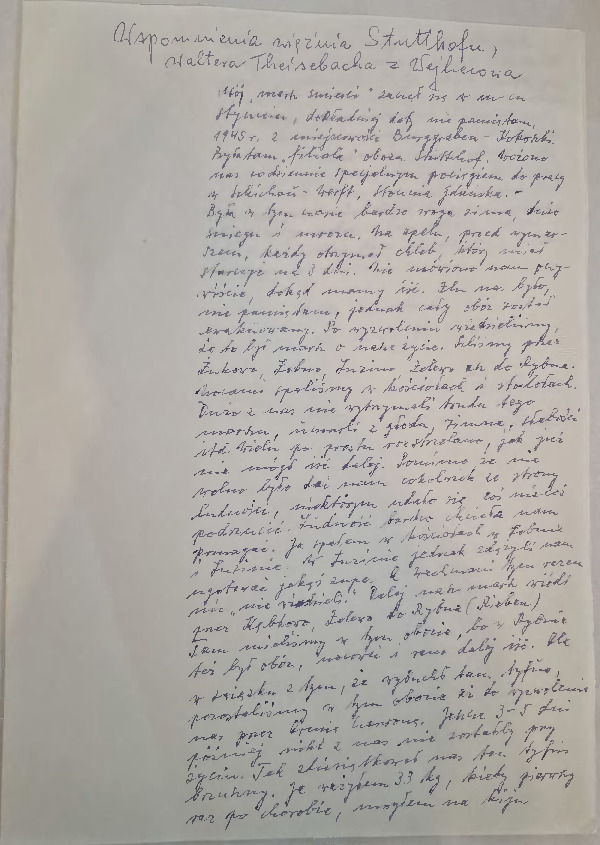 Luzino Relacja Anny Drabik ur. 1933 r
Contact and cooperation
We are still looking for information on the identity of the victims and the location of Jewish graves in Luzino. If you know something more, write to us at the following address: kontakt@zapomniane.org.
Bibliography
Grabowska J., Marsze śmierci. Ewakuacja piesza więźniów KL Stutthof I jego podobozów 25 stycznia-3 maja 1945, Sztutowo 2003
Testimony of Anna Drabik, born 1933, Cultural Center archives in Luzino
The materials published on this website were developed, digitized, and made available thanks to funding from the Minister of Culture and National Heritage through the Culture Promotion Fund, as well as support from the Embassy of the Federal Republic of Germany in Warsaw, which also enabled the creation of the English-language version of the website.