Łazy
Borough: Łazy, District: zawierciański, Voivodeship: śląskieType of place
Forest and marshy terrain - the grave is located on plot no. 475 in the area of Łazy, Łazy borough, zawierciański district.Information about the crime
At the end of the 1960s, the Regional Commission for the Examination of German Crimes in Katowice conducted an investigation regarding German crimes committed in the forced labor camp in Łazy in 1943-1944. Several residents of Łazy were interviewed. According to their accounts, approximately 1,000 prisoners were held at the camp. They were men from Germany, France, Belgium, the Netherlands, possibly Greece, and other European countries. Among them were also Polish Jews who had lived in Western Europe before the war. Conditions in the camp were extremely difficult: starvation rations, exhausting labor beyond their strength, and the brutality of the guards. The victims of the camp were buried in marshy ground on Częstochowska Street in Łazy, near a World War I military cemetery.
On April 25, 1968, Henryk F., a resident of Zawiercie, wrote to the Chief Commission for the Examination of German Crimes in Poland providing information about the location of mass executions carried out by the Germans on the Jewish population in 1943–1944 in Łazy near Zawiercie. “These graves will be difficult to find as the areas, overgrown with grass and small woods, conceal the traces of the crimes. However, I believe that with the help of the local population, they could be located. I am writing this letter in response to an appeal broadcast by Polish Radio. (IPN Ka 864/57)
Two months later, Henryk F. made the following statement to the district attorney in Częstochowa as part of an investigation conducted by the Regional Commission for the Examination of German Crimes in Katowice: “I believe that in the fall of 1943 or the spring of 1944, while working on the construction of telecommunications networks stretching along the railway tracks between Łazy and Zawiercie, I saw Jewish workers transported in freight cars from the Katowice to Sosnowiec, who were employed by the Germans on the railway tracks. […] The people – all men – were dressed in denim. We had difficulty communicating with them, as they spoke a language we could not understand – they were probably Greeks. […] Between 3 and 5 p.m., the Germans guarding the workers led them outside the town of Łazy to a nearby forest (now near the health center), from where only the German staff returned. In the meantime, we heard gunshots.” (IPN Ka 864/57)
From the testimonies of subsequent witnesses, it can be concluded that at that time, the residents of Łazy witnessed the suffering and death of camp prisoners on a daily basis.
Leopold Z.: “During the occupation, I lived with my mother and grandparents in Łazy. In 1942–1943, the German authorities established a camp for Jewish male civilians at the intersection of Wysocka and Fabryczna Streets. About eight barracks were built, including one for the kitchen, one for storage, and one for the German guard post, administration and duty room. The entire camp was surrounded by barbed wire and fenced in with mesh, so that there was only one exit from the camp, next to the guard post and duty room. […] Jews were brought to this camp in freight cars in the summer of 1942. From conversations with them, I learned that they were from France and Belgium and could communicate in Polish. It was a fairly large group of people – I estimate about 1,000 people. […] I saw that the Jewish prisoners were taken daily from the camp to the nearby railway tracks, where they were forced to work. They worked on the tracks from morning until evening. […] During the winter period, I saw on several occasions bodies of Jews who had died from exhaustion or starvation being taken away on platforms and buried in an alder forest on marshy ground near the house of a citizen named C. in Łazy. cannot say how many of these Jews died, as after burial the graves were leveled, and several Jews were buried in a single grave.” (IPN Ka 864/57)
Roman Stanisław S.: “[…] After returning to Łazy, I noticed that opposite my house there was a square belonging to Maria M., on which a large group of about 500 men of Jewish origin were camped. The square was fenced off with barbed wire and guarded by German soldiers. There were also several Jewish women from Będzin who served the German administrative staff. […] Among the camp prisoners were Jews from France, Belgium, and the Netherlands. […] I personally witnessed a young German guard murdering one of the Jews at the entrance gate with the butt of his pistol. Moreover, several times a week, I saw Jews Jews from the camp taking on a small cart, pulled by other Jews, what appeared to be the bodies of Jews who had died or been killed. The bodies were buried near the home of Stanisław C., across from the German World War I military cemetery, in an alder grove. It is known that after liberation, exhumations of corpses were carried out there, but I do not know where the bodies were taken. Jews were employed on the railroad tracks, ballasting the tracks, building water towers, and performing other tasks. […] It seems that at the end of 1943, they were transported somewhere, but I cannot say where – probably to Auschwitz-Birkenau.”
Józef L.: “At the turn of 1942-1943, I don’t remember the exact date, the German railway authorities set up a camp for Jewish civilians in Łazy, at the junction of Fabryczna and Wysocka Streets. There were about 500 people, dressed in civilian clothing, speaking German and French. They spoke German and French. These Jews worked on the construction of a water tower, excavation for water pipes, and the construction of railroad tracks. […] The Jews were guarded by about 20 Germans in guard service uniforms with swastikas on their left sleeves, mostly young men. […] Sometimes I saw the bodies of dead Jews being taken away from the camp on a handcart and buried near the house of Stanisław C. on Częstochowska Street in Łazy. I estimate that around 100 Jews were taken from the camp. No one can say the exact number, as the dead were transported both day and night, and no graves were left because the earth was leveled. […] Late in the autumn of 1944, as the Eastern Front approached, the German authorities liquidated the camp, transporting the Jews by freight train to Katowice.”
Maria M.: “I heard from friends that one of the Jews was supposedly from Vienna and was a musician. While finishing work on the water tower, he jumped from a significant height onto the debris and died, driven to this by the German guards.”
Jerzy M.: “I was born in 1934, so during the period when the camp existed, I was a boy aged eight to ten. […] The camp prisoners were mainly employed in railway works, including the construction of an office building that also served as a water tower for the Polish State Railways. It was a seven-story building. While hanging around the construction site, I once witnessed either a suicide jump from the top floor or one of the prisoners being pushed off. […] Every morning, and sometimes in the evening, I saw the dead, and possibly murdered prisoners being transported, naked and covered with cement sacks, on a cart by fellow inmates to the nearby forest, where they were buried in mass graves. My friends and I would sometimes go to the forest to watch where and how the dead prisoners were buried. This was done by preparing a pit large enough to hold several people, into which the bodies were placed over several consecutive days, usually two or three days, with the bodies being covered with some kind of chemical substances, probably disinfectants. At the beginning, for a short period, it was possible to make contact with prisoners working near the railway barbed wire fences. As an amateur stamp collector, I received stamps from them, and once even a tiny leather wallet with the Eiffel Tower emblem embossed on it from one prisoner, in exchange for which I would give them food supplies like bread, onions, and other vegetables. I vividly remember that the prisoners were exhausted to the very limits of endurance.”
Jan H.: “During the occupation, from 1940, I worked at the railway locomotive shed in Łazy near Zawiercie. It could have been in 1942 or 1943, in the summer, walking along a side road to the locomotive shed, I came across a camp guard near the water tower. He was very young, around 20–25 years old. The guard hit an elderly prisoner, probably 40–45 years old, on the back of the head, which made him bend heavily toward the ground. I felt sorry for him and, from about 20 steps away, spoke to the guard in German, asking if whether he felt any remorse for hitting a man. The guard replied that I should leave immediately. Feeling afraid, I went on my way. I did not see what happened next. I heard no gunshots then.”
Stanisław C.: “The food in the camp was very scarce, as I saw Jews returning from work who, weakened and exhausted, would collapse along the way. Some of the weakened Jews were led on, while others were killed on the road. The killed Jews were transported on a two-wheeled cart by other Jews to a forest near my place of residence, and there, in marshy ground, they were buried so as not to leave any graves; the ground was levelled. […] Sometimes I heard screams and pleas coming from the camp.”
We visited Łazy for the first time in the spring of 2022. We visited the site of the camp and the water tower, during the construction of which camp prisoners lost their lives. We returned to Łazy several times, trying to locate the place where the bodies of murdered Jews had been buried. We had several meetings with people living in the immediate vicinity of the forest, where unmarked graves are believed to be located. Each of them had heard about the burial sites in the forest, but so far it has not been possible to precisely locate the exact place where the bodies of the camp victims in Łazy were buried. In 2022, we met with the then decorator of the Cultural Center in Łazy:
– There were no Jews from Poland here, but from Western Europe. France, Belgium.
Zapomniane: Transported first to Auschwitz?
– No. At first, probably directly here. And then, no one knows what happened to them. There are different accounts. […] From what this lady told us, she regularly delivered milk here as a ten-year-old girl. She said that when she walked along this road and reached this point, she was afraid to even lift her head because the military policeman, the guard…
Zapomniane: Was he harsh?
– He was harsh, fearsome. She said she couldn’t really look around. But she remembered that there were wooden barracks here and pointed out the location. That was a few years ago, so we can still walk a little further, because it’s probably a little further away. Yes, it’s at the level of that large abandoned house. […] Conditions here were tough, maybe not hopeless, but tough, and people died here mainly from exhaustion and disease. There were no standard executions here…
Zapomniane: On a daily basis?
– Yes, yes.
Zapomniane: So where did those 200 [victims] come from? During the evacuation?
– Because of these conditions. […]
Zapomniane: Were these prisoners buried in a single pit?
– There was one pit. There was one pit, and it was said that when the frost was very severe, the bones would stick out, or something like that. They transported the dead prisoners; the camp was at the end of that road. They carried them here on a cart, maybe two prisoners at a time. And there was some kind of depression, a hollow, into which they supposedly threw them… This area is generally very marshy.
Zapomniane: And was it always like that?
– Yes. This area also has clay soil; clay was extracted here, and there were brickworks, so one thing is connected with the other. It’s said that the prisoners were buried in this pit. I have 70 recorded testimonies. I asked if they were ever exhumed, and no one was able to answer me. […] They laid tracks, but that’s not all. The water tower building, which you visited, was built by them. It was constructed entirely by the prisoners. The entire area near the railway tracks was also rebuilt; it was their work, because it looked completely different before the war. (Łazy, 2022)
Commemoration
In May 2024, a plaque commemorating the victims of the German labor camp was unveiled at the Roman Gostkowski School in Łazy.
IDENTIFICATION OF THE GRAVE BASED ON NON INVASIVE RESEARCH
The exact location of the cemetery remains unknown; but its northern boundary is defined by a drainage ditch, which still exists today. It appears on a sketch made by Leopold Z. and is included in the investigation files concerning German crimes committed against the Jewish population in the forced labor camp in Łazy in 1943–1944 (Ref. IPN Ka 864/57, p. 24).
Sources
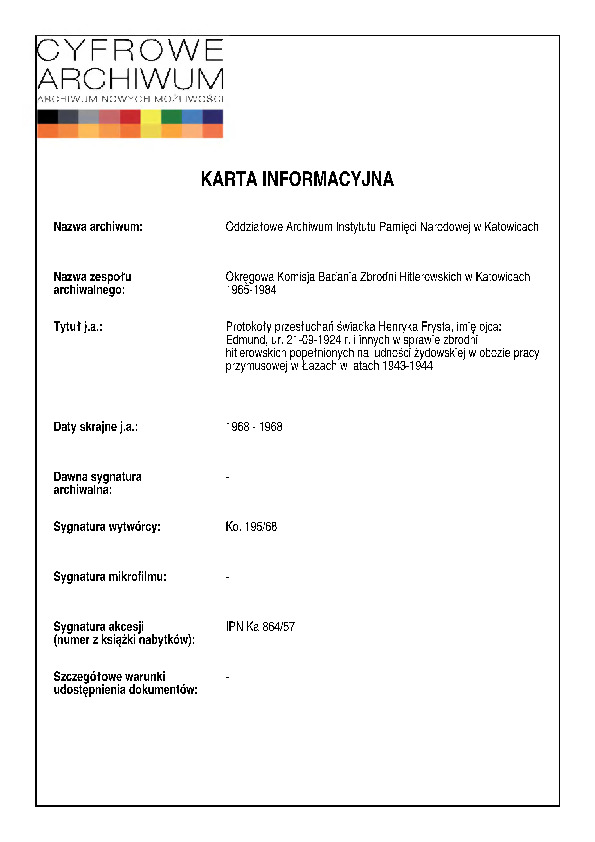 Łazy Protokoły przesłuchań świadka Henryka Frysta, imię ojca_ Edmund ur. 21-09-1924 r. i innych w sprawie zbrodni hitlerowskich
Contact and cooperation
We are still looking for information on the identity of the victims and the location of Jewish graves in Łazy. If you know something more, write to us at the following address: kontakt@zapomniane.org.
Bibliography
IPN Ka 864/57 Transcripts of interrogations of witness Henryk Fryst, father’s name: Edmund, born on September 21, 1924, and others in the case of German crimes committed against the Jewish population in the forced labor camp in Łazy in 1943–1944.
Recording of the Zapomniane Foundation (audio file), Władysława W., interviewed by Andrzej Jankowski and Aleksander Schwarz, Łazy, April 3, 2024.
Recording of the Zapomniane Foundation (audio file), director of the Municipal Cultural Center in Łazy, interviewed by Andrzej Jankowski and Agnieszka Nieradko, Łazy, 2022.
The materials published on this website were developed, digitized, and made available thanks to funding from the Minister of Culture and National Heritage through the Culture Promotion Fund, as well as support from the Embassy of the Federal Republic of Germany in Warsaw, which also enabled the creation of the English-language version of the website.