Księżpol
Borough: Księżpol, District: biłgorajski, Voivodeship: lubelskieType of place
On the Tarnogród–Biłgoraj route, near Blicharz’s land, near the village of Płusy. Near the village of Księżpol, in the so-called “Łukowiec,” by the Tarnogród–Biłgoraj road. By the Tanew River in the village of Księżpol, on Katarzyna Markowicz’s land. By the same road near the village of Księżpol, on Mikołaj Markowicz’s land. In a small birch grove near Księżpol. In a meadow approximately 40 meters from the former police station. Near Księżpol village, under a slope. On Gabriel Telekała's field. On a hill located on Franciszek Wryszcz’s field in Księżpol. Behind the church, on the way from Biłgoraj to Tarnogród.Information about the crime
The largest massacre of the Jewish population took place in November 1942 during the deportation of Jewish residents of Tarnogród to Biłgoraj and further on to extermination camps. During the march, police officers from the Ukrainian police station in Księżpol murdered several hundred people. The victims’ bodies were buried in numerous graves, the exact locations of which remain unknown. However, the survey carried out by The Chief Commission for the Examination of German Crimes in Poland provides information that may help identify these sites in the future:
- On November 2, 1942, while escorting Jews
WHERE THE BODIES WERE BURIED:
on the Tarnogród-Biłgoraj route near Blicharz’s land, near the village of Płusy, 30 Jews.
DESCRIPTION OF THE GRAVE:
A deep pit measuring 12 m² was dug and 30 people were buried in it. The grave was covered with earth and levelled with the ground. No exhumation was carried out.
- November 2, 1942, on the Tarnogród-Biłgoraj route
WHERE THE BODIES WERE BURIED:
- near the village of Księżpol, known as ‘Łukowiec’, by the Tarnogród-Biłgoraj road,
- by the Tanew River in the village of Księżpol, on Katarzyna Markowicz’s land, and
- by the same road near the village of Księżpol, on Mikołaj Markowicz’s land.
DESCRIPTION OF THE GRAVE:
- a deep pit measuring 6 m² was dug, and the aforementioned 40 victims were buried near the village of Księżpol, in the so-called “Łukowiec,” by the Tarnogród–Biłgoraj road,
- a pit measuring 6 m², 12 victims were buried by the Tanew River near the village of Księżpol, on Katarzyna Markowicz’s land
- a pit measuring 6 m², 30 victims were buried on Mikołaj Markowicz’s land, the pits were filled in and levelled with the ground
- November 2, 1942
WHERE THE BODIES WERE BURIED:
By the Tarnogród–Biłgoraj road in the village of Markowicze during the escort of the Jewish population.
DESCRIPTION OF THE GRAVE:
Approximately 60 people were buried in several graves located several kilometres apart, with several victims in each grave, near the road over a distance of one kilometer. The graves were filled in and leveled with the ground. (IPN GK 163/12)
The following notes were made during a query of the eight-volume investigation files concerning crimes committed by officers of the Ukrainian police post in Księżpol (IPN Lu 023/62). The file query focused on information regarding executions, burials, and the identities of the victims.
Volume 1
“In the winter of 1942/1943, Michał Żur and Michał Pawłyszyn shot approximately 10 Jews, including a Jew named ‘Isier’ from Rakówka, in a small birch grove near Księżpol. On Żur’s orders, the local residents buried the victims’ bodies at the crime scene.” (p.20)
“In the spring of 1943, Michał Żur and Michał Pawłyszyn shot and killed five Jews in a field in Księżpol, about 40 metres from the then police station. The bodies of the victims of this crime were buried by the police officers by the Tanew River.” (p.21)
“Kuropczuk Natalia, resident of Księżpol, witnessed Michał Żur personally killing three Jewish children behind her barn in 1941.” (p.25)
“In 1942, Stanisław Rybak, residing in Biłgoraj at Bojary Street, witnessed four Ukrainian policemen execute three Jewish women named Helena, Łajka and Jeda by the Tanew River. He recognised two of the policemen as Michał Żur and Jan Buryła.” (p. 25)
“In 1941, Antoni Dolina, son of Michał, residing in Księżpol, witnessed Michał Żur personally shooting Jewish people near a dug pit.” […] “The chairman of the GRN in Biszcza, Mr. Stanisław Blicharz, reported that Żur and the policemen under his command shot several Jews in Biszcza in 1943.” (p. 26)
“The commander of this station was Michał Żur, and one of the most active policemen was Michał Pawłyszyn. In the winter of 1942/1943, police officers from the police station in Księżpol shot about 10 Jews, and in the spring of 1943, they killed 3 Jews by the Tanew River.” (p. 30)
“According to unconfirmed reports, the policemen from the Księżpol station committed the following murders in the autumn of 1943:
- In Księżpol, they executed a Jewish family of three, including a young girl.” (p. 59)
“In the summer of 1941 or 1942, I was delivering milk to the collection point in Księżpol, when Michał Żur and Pohajduk took a Jewish acquaintance of mine, named Aryś, out of the police station. They had arrested him the day before in the village of Księżpol. They took him outside the village to a slope and shot him there. […] More people were shot under that slope, most of them Jewish. Many of these people are buried there.” (p. 86)
“On December 2, 1942, on the orders of village head Jerzy Przepiórka, together with other residents of Księżpol (he does not remember their names), he participated in placing Jewish bodies into three pits located in Księżpol. On that day, Jews were being driven from Tarnogród to Biłgoraj. He [Stanisław Budzyński] knows that his father witnessed the shooting of two Jewish women by the Tanew River by Żur and Pawliszyn. One of these Jewish women was his friend Hendla Kloc.” (p. 106)
“At an unspecified time, [Katarzyna Rarata] personally witnessed M. Żur shoot three Jews, including two children. At that time, she was grazing a cow near the site of the killings.” (s. 107)
“Markowicze: approximately 60 Jewish people were shot.” (p. 129)
“In the summer, he cannot remember which year, while grazing cows in a meadow in Księżpol, Stanisław Rybak saw three or four policemen from the Księżpol station, including Żur, leading the three daughters of Boruch, the Jewish tailor from Księżpol: Handla, Łajka, and Ida. A fisherman hiding in the bushes saw the police shoot these Jewish women. He does not know who buried the bodies, but he remembers where they are buried. He would be able to point out the place.” (p. 185)
“Natalia Kuropczuk: Żur, without the help of other policemen, led three Jewish children aged 8-12. I cannot remember their genders. The children were crying and begging Żur not to kill them. Mrs. Koropczuk, frightened, hid in her house, and within no more than five minutes, she heard gunshots. After some time, when she left the house, she saw the bodies of the children. All this happened behind her barn. The bodies of these children were buried not far from the place where they had been killed by a farmhand working for her neighbors. She does not remember his name, knowing only that he has since died. After liberation, the bodies of these children were moved to another location, but I do not know where. I am unable to determine what the children’s names were or where they came from.” (pp. 190–191)
“G. Telekała’s father, Jan (now deceased), witnessed Żur shooting a Jewish woman from Tarnogród. Her body and the bodies of 18 other Jews are buried in Gabriel Telekała’s field.” (p. 193)
“In the autumn of 1943, the Germans drove about 200 Jews from Tarnogród to Biłgoraj, shooting those who could not keep up with the march and fell behind. Mikołaj Sochacz was appointed by the village head to collect the bodies lying along the road and take them to a mass grave. While riding a cart on the road between Płusy and Księżpol, he saw Żur standing alone. According to Sochacz, Żur was finishing off those who had been wounded by the Germans with shots from his pistol. He witnessed this event firsthand from close range. Żur shot four Jews at that time. The bodies of the murdered victims were buried on a hill in the field of Franciszek Wryszcz from Księżpol and remain there to this day. Mikołaj Sochacz witnessed Żur and Wacyk leading a 12- to 13-year-old Jewish boy and girl. This occurred in Księżpol; the children had been hiding in the village of Pisklaki and were probably betrayed by someone. Standing near the post office, Sochacz saw Żur and Wacyk leading the children toward Natalia Kuropczuk’s premises. About ten minutes later, he heard gunshots coming from that direction. According to Sochacz, the bodies of these Jews were buried by Wasyl Pawlicha (now deceased) and Jan Hanas (currently living in the USSR). Sochacz did not know the murdered Jews; he states that they probably came from Tarnogród.” (p. 217)
Volume 2
“A military policeman from Tarnogród killed a Jew named Hysier, who came from Rakówka. After the murder, Hysier and Maciej Legieca were buried by local people near the Tanew River. A few days later, at the family’s request, the military policemen from Tarnogród allowed Legieca’s body to be taken from that site and buried in a cemetery.” (p. 20)
“Several Jewish citizens were killed in Biszcza. The witness, Stanisław Blicharz, did not know the victims. In the autumn of 1943, he does not remember the exact date, he saw policeman Buryło and another man, whom he did not know, leading a young Jewish woman who said: what a beautiful and joyful world it is, and she has to die because of Hitler. They led her into a ravine in Biszcza. After a moment, the witness heard gunshots. He knows where the killing took place. The woman was reportedly from the Lublin area. […] Lewkowicz Szczepan: in winter, he does not remember the date, he saw Ukrainian policemen shoot about 10 Jews, including one child. The murder took place behind the barn of Jan Kozioł, who was at that time working in Germany. Agnieszka Maziarz was living in that house at the time. […] Before the execution, one of the Jews was wearing three shirts. He begged the policeman (Piorun) with one shirt on, but the policeman ordered him to take them all off. Once he had removed them, he was told to lie down, and then the policeman shot him The Jew Lejbko was shot near the police station in Księżpol. […] In the spring of 1943, Michał Żur and several other policemen arrested Jan Kukiełka, who died in Auschwitz for hiding Jews. On that day, they arrested a Jewish man and a Jewish woman in Michał Hubka’s buildings, and a minor Jew, Lejbka, at Michał Kruk’s buildings. They were all shot near the police station in Księżpol.” (pp. 26-27)
“In November 1942, in Księżpol, [M. Pawliszyn], together with M. Żur, killed two Jewish children (testimony of J. Kowal).” (p. 147)
“Identify witnesses to the murder of Boruch Kloc’s family from Rakówka and question them. Prepare visual documentation of the crime scene. […] Carry out the exhumation of one of the mass graves of Jews murdered on November 2, 1942, along the Tarnogród–Biłgoraj route. Prepare photographic documentation.” (p. 181)
Report regarding Pawliszyn:
“- At the turn of 1942–1943, in Księżpol, they shot about 10 Jews, including Isier from Rakówka.
– In the spring of 1943, in Księżpol, together with M. Żur, they shot six Jews near the police station.
– On an undetermined date in Księżpol, together with M. Żur, they shot Hendla and Łajka Kolc by the Tanew River.
– In November 1942, in Księżpol, together with M. Żur, they shot two Jewish children.” (p. 185)
Witnesses in the case of M. Pawliszyn:
- Michał Kusiak witnessed the shooting of 11-13 Jews in Rakówka.
- Jan Dudko (senior) probably witnessed the killing of the daughters of the Jewish man Kloc. (p. 224)
“Accordingly, I request that you speak with the residents of Księżpol, Franciszek Lisiczka, or his wife Wanda. Did they witness the Ukrainian policemen finishing off Jews driven from Tarnogród to Biłgoraj on November 2, 1942, along the road by the Lisiczka property?” (p. 260)
“Wanda Lisiczka recalls the scene of the Jews being driven from Tarnogród to Biłgoraj in vivid detail, as she watched it from the windows of her attic. There were many dead along both sides of the road after they were led through. The local population collected the bodies of the murdered Jews and dug a communal grave behind the church, on the way from Biłgoraj to Tarnogród. Around 40 people had been buried then. Bronisław Lisiczka claims that he knows from stories that the police from Księżpol abused an 18-year-old boy from Rakówka, who was later executed.” (pp. 262-263)
“On 24 November 1972, an exhumation took place in Księżpol on a meadow by the village road, at the location indicated by witness Bolesław Sprysak as the grave of 12 Jews shot in the autumn of 1942. The outcome was negative.” [p. 266]
“M. Żur carried out his operations in the villages of Rakówka, Markowicze, Żynie, Żanie, and Króle.” (p. 268)
“Charges pressed against Pawliszyn:
- In the autumn of 1942, on an unspecified date, together with M. Żur, he shot 12 people of Jewish nationality.
- On November 2, 1942, on the route from Tarnogród to Biłgoraj, together with Żur, Buryła, and Łotysz, he shot 30 people of Jewish nationality.
- In November 1942, on an unspecified date in Księżpol, he shot four people of Jewish nationality, including a small child.” (p. 303)
“Policeman Łotysz participated in the mass execution of Jews in the so-called stream behind the village of Biszcza. At another time, he shot a Jewish woman and then buried the wounded woman, when she was still alive.” (p. 326)
Volume 3
“Until 1942, the village of Biszcza was home to 14 Jewish families, totaling approximately 60 people. In the autumn of 1942, Sadowy issued an order that people of Jewish origin report to the Municipal Office, where they were placed in one cell of the local prison under inhumane conditions. On the following day, the policemen from the local station escorted all Jews, including women and children, to Tarnogród.” (p. 55)
“The Municipal Office in Księżpol hereby certifies that the civil registry office lacks death certificates of the following citizens in the registers for the years 1940–1944:
- Kloc Boruch, son of Matys, born in 1885
- Kloc Syma, daughter of Hul, born in 1899
- Kloc Hendla, daughter of Boruch, born in 1920
- Kloc Idessa, daughter of Boruch, born in 1926
- Kloc Łaja, daughter of Boruch, born in 1922
- Kloc Sara, daughter of Boruch, born in 1928
- Kloc Szymon Berko, son of Boruch, born in 1937
- Kloc Majlech, son of Boruch, born in 1940
- Kloc Sara, daughter of Matys, born in 1906
- Kloc Matys, son of Szymon, born in 1898
- Isier Hinio, no further details available
All of them were residents of Rakówka.” (p. 80)
“The German military police from Tarnogród committed numerous murders of people persecuted by the German authorities. Among other actions, they participated in the shooting of approximately 3,000 Jews, residents of Tarnogród, in the summer and autumn of 1942.” (p. 99)
“In the autumn of 1942, Żur and Pawliszyn shot the eight-member family of Kloc Boruch, a Jewish tailor and permanent resident of the village. Kloc Boruch and his family owned the house number 11.” (p. 117)
“In November 1942, in Księżpol, Pawliszyn and Żur executed two Jewish children, aged 10 and 13. After being taken from the jail, they were shot in a nearby grove located to the east of the police station.
In autumn 1942, in the village of Księżpol, Pawliszyn and Żur shot 12 people of Jewish nationality, including 4 men, women and children. The murder took place in the immediate vicinity of Franciszek and Weronika Sprysak’s property, near the post office building. The victims had previously been captured in the forest near the village of Lipowiec, in a bunker where they were hiding.
On November 2, 1942, in Księżpol, Pawliszyn, together with Żur, Buryła, and Łotysz, took part in finishing off by rifle shots approximately 30 Jews, both adults and children. The victims were wounded survivors from the Jewish column driven that day by the Germans from Tarnogród to Biłgoraj.
In November 1942, in Księżpol, Pawliszyn shot four Jewish people in the presence of Żur: two men, a woman and a small child, previously taken from the police station. He shot the adults in a grove belonging to Aleksy Szczur, and the child next to the buildings of Franciszek and Weronika Sprysak.” (p. 131)
“Police officers from Biszcza, particularly the officer Łotysz, participated in the mass execution of Jews in 1942 at the so-called stream behind the village of Biszcza.” (p. 153)
Żur, after the march of the column from Tarnogród to Biłgoraj: “There were already several carts on the road. People placed the bodies of the Jews on them and transported them to the pits dug in the fields of farmer Markowicz. There were two pits there, into which bodies were thrown. One of the pits was located near the Tarnogród-Biłgoraj road, the other a little further away in the so-called Łukowiec. At the beginning of autumn 1943, one of the residents of Rakówka brought in a Jew and two children, a girl aged about 15 and a boy aged 3-4. I do not remember the Jew’s name, but Żur knew him from before the war as the owner of a shop in Rakówka. The Jews were held in a cell for the night. The next morning, a military policeman came and ordered their execution. Then Żur asked Antoni Kowal from Księżpol if a pit for the bodies had been dug and where it was. Kowal answered that it was behind the post office, near the grove. The pit was dug 200–250 meters from the police station. shot two daughters of the Jew Boruch near the Tanew River (two pits had already been dug). Boruch had lived in Rakówka before the war and was a tailor.” (pp. 182-183)
“Ludwik Nowiński and Jan Kusiak witnessed Żur and another policeman shooting four Jewish people, two children and two adults, on a small hill near the buildings of Stanisław Blicharz in December 1942.” (p. 185)
“In September 1941 or 1942, Grabis witnessed the shooting of a resident of Tarnogród, Aryś, whose father was a horse trader. Aryś was 17 years old at the time. Żur and Podhajdak committed the murder 100–150 meters from the police building toward the west, on the dirt road leading from Księżpol towards the airport.” (pp. 193-194)
“According to Żur’s interrogation, the murder of three Jewish children near the buildings of Natalia Markowicz took place in the spring of 1943. In late autumn 1943, someone brought two Jewish men, an elderly Jewish woman and two children aged 10, a boy and a girl, to the police station. The Jews were led out of the police building and taken to a field behind the post office, where, near the road leading to Biłgoraj, they were shot. This was about 100 metres from the post office building.” (pp. 205–206)
“In the autumn of 1942, Żur participated in the execution of two young Jewish boys, aged around 15. Together with Pawliszyn, he led the boys out of the police station and led them behind the post office, down a road to a small forest. About 50 metres from the forest, they stopped and shot the boys. Żur told Piórko, the village head, to bury the bodies of the victims.” (p. 211)
After the march of the column from Tarnogród to Biłgoraj:
“There were many bodies lying on the road. People placed the bodies of the dead on carts and carried them to two pits dug in the Markowicz field and in the so-called Łukowiec. In the autumn of 1943, two Jews, an elderly woman and two Jewish children from Rakówka, were brought to the police station. Wacyk and Żur shot them in the field behind the post office.” (pp. 215-216)
“Żur personally shot Gisier Lumermann, the owner of a shop in Rakówka. Stefan Zań testified that in 1942 or 1943 (it was cold), he saw Żur and five policemen leading Gisier Lumermann toward the forest, along with three children and two or three adults. They led them towards a dug pit.” (p. 223)
“In 1943, Eudokia K [illegible], former maid of M. Żur, saw him bring a 6- to 7-year-old girl, wearing an old coat, out of the police station and lead her into the field. At one point, he told her to run, and when she tried to escape, he shot her. After the killing, people told him that she was Jewish.” (p. 266)
“Confrontation between Żur and witness Stefan Zań: besides Lumermann, he also shot the girls accompanying him. One of them was about 15 years old, the other 3–4 years old. They were Lumermann’s daughters.” (p. 276)
Report regarding M. Żur:
“- In 1941 or 1942, the exact date was not determined, together with police officer Podhajdak, he shot Aryś, a Jewish resident of Tarnogród, in Księżpol near the airfield.
– In autumn 1942, in Księżpol, together with policeman M. Pawliszyn, he participated in the shooting of two Jewish boys whose names are unknown.
– On November 2, 1942, in Księżpol, on the Biłgoraj-Tarnogród road, he shot two Jews whose names are unknown.
– On November 3, 1942, in Księżpol, on the Biłgoraj–Tarnogród road, he shot a Jewish woman who had been wounded in the leg. Her name is unknown.
– In 1942 or 1943, the exact date is unknown, near Natalia Markowicz’s buildings in Księżpol, he shot three Jewish children whose names could not be established.
– In December 1942, in Księżpol, together with other police officers, he participated in the shooting of four Jews, including two children whose names could not be established.
– In the autumn of 1943, in Księżpol, he shot the Jew Isier Lummerman and two of his minor children.
– In 1943, in Księżpol, together with M. Pawliszyn, he shot the Jewish women Hendla and Łajka Kloc.
– In the autumn of 1943, in Księżpol near the post office, together with M. Pawliszyn and other policemen, he participated in the shooting of five Jewish civilians from Rakówka.
– In 1943, in Księżpol, he shot a young Jewish girl whos name is unknown.” (pp. 312-312)
Sources
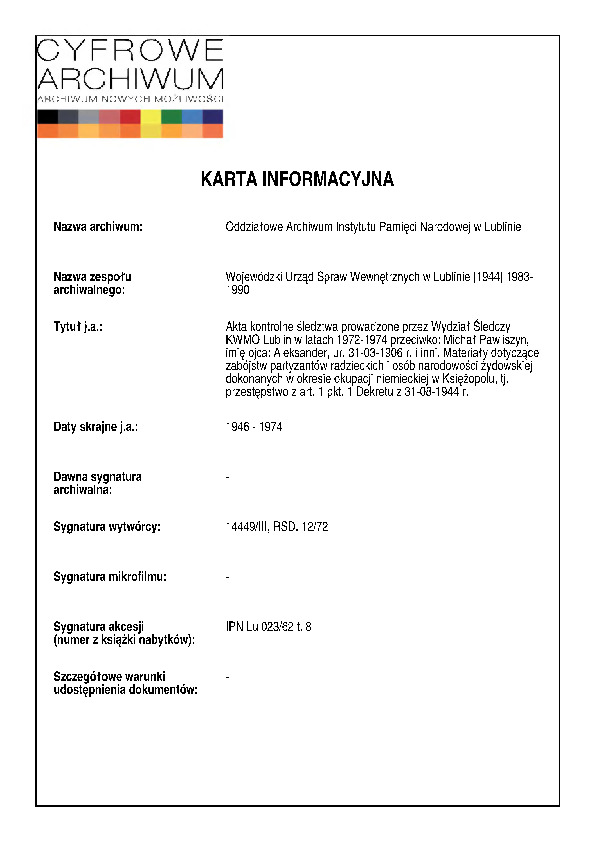 Księżpol Akta kontrolne śledztwa prowadzone przez Wydział Śledczy KWMO Lublin w latach 1972-1974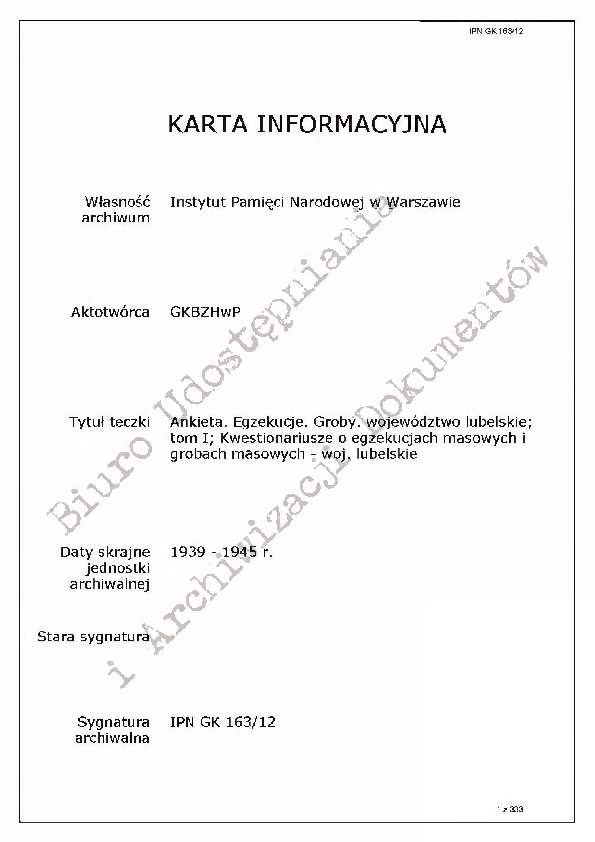
Contact and cooperation
We are still looking for information on the identity of the victims and the location of Jewish graves in Księżpol and the surrounding areas. If you know something more, write to us at the following address: kontakt@zapomniane.org.
Bibliography
IPN Lu 23/62, volume 1-8, Control records of the investigation carried out by the Criminal Investigation Department of the Voivodeship Civil Militia Headquarters in Lublin in years 1972-1974 against: Michał Pawliszyn, father’s name: Aleksander, born on 31 March 1906, and others. Documentation regarding the killings of Soviet partisans and Jews in Księżpol during the German occupation, i.e. a crime under Article 1(1) of the Decree of 31 August 1944.
IPN Gk 163/12 Survey. Executions. Graves. Lubelskie voivodeship; volume 1; Questionnaire on executions and mass graves – lubelskie voivodeship
The materials published on this website were developed, digitized, and made available thanks to funding from the Minister of Culture and National Heritage through the Culture Promotion Fund, as well as support from the Embassy of the Federal Republic of Germany in Warsaw, which also enabled the creation of the English-language version of the website.