Czajkowa
Borough: Tuszów, Narodowy District: mielecki, Voivodeship: podkarpackieType of place
Forested area.Information about the crime
In August 2021, we carried out a site inspection of the place where the grave of the Jewish Brenner family, murdered in August 1942 in Czajkowa, was believed to be located. The archives of the Institute of National Remembrance contain information about the killing of seven Jews in Czajkowa, Sarnów borough, in August 1942. The victims’ bodies were buried in a single grave near the Czajkowa–Majdan Kolbuszowski road, approximately 100 meters from the village. (S 08/04/Zn)
Information regarding the crime in Czajkowa had been gathered in the 1980s as part of an investigation conducted by the Voivodeship Prosecutor’s Office in Rzeszów under Article 1, point 1 of the decree of 31 August 1944 concerning crimes committed in Mielec and Tuszów Narodowy.
Official note written by Sergeant Antoni Soja in Tuszów Narodowy on 12 December 1982:
“On 2 December 1982, in the course of official duties carried out in Czajkowa, I questioned Jan Paterak, son of Jan, born on 15 August 1909, regarding the executions and murders committed by the Germans. The questioning concerned the execution of the Brenner family mentioned in point 11 of your letter. During the questioning, the above-mentioned stated that he had been an eyewitness to the execution of seven members of the Brenner family in Czajkowa. On 8 August 1942, he was taken from his home by the Germans for execution and led to the Brenner premises, where he was to be shot along with them. […] At the Brenner premises, the German soldier Wojtas lined up the entire Brenner family and asked them why they had not fled to Baranów when they had been ordered to do so a few days earlier. They stated that they had nowhere to escape […] Meanwhile, Mayor Antoni Kłoda, a resident of Jaślany, gave the order to execute them on the spot. On Kłoda’s orders, the nearby neighbor Franciszek Gudz […] was called and ordered to dig a pit for the entire Brenner family. Once the grave had been dug, the German Wojtas carried out the execution of the Brenner family. First, he shot the three children above the pit, then he shot their parents, and then the father and mother of the previously executed children’s couple. After the execution, Franciszek Gudz filled in the grave, located near buildings now owned by Władysław Jacek. Franciszek Gudz is able to indicate the location of the grave. […] Further details may be provided by […] née Apsterdam [original spelling], resident of Czajkowa, who is a member of the Brenner family. (S.8.2004.Zn)
The location of the alleged grave is well known to the residents of Czajkowa. On 25 November 2003, during earthworks in Czajkowa, an excavator operator discovered human remains, which most likely belonged to the victims of the 1942 murder. The statements below were gathered by the Mielec District Police Department regarding this incident.
Władysław J. (b. 1914):
“Regarding the question about the bones discovered near my house, it is reported that they are the remains […] of three Jewish families, who, fleeing from the Germans from Sarnów, formerly the German colony REISHEIM, were hiding in the forests and in an empty, uninhabited house formerly owned by the Kamuda family. They stayed there for about three months. There were about eight people there. From what I remember, there was an elderly man around 80 years old, an older woman of the same age, most likely his wife. I knew them well, as they would secretly come to our house for milk, bread, and other food. I didn’t know their last name. I know that the locals said they were [inaudible]. In addition to the previously mentioned man and woman, there were their two daughters in the house, both around 35 years old. I am sure there were four children as well. I remember the day of the crime against them very clearly. It was August 15, 1942 — the Assumption of Mary. That day, around noon, looking out of the window of my house, I saw several Germans leading the Jews I mentioned earlier out of the house toward a pit dug by Wojciech P., Franciszek G., and Wojciech F. The Germans forced them to dig the pit. I watched it and heard several gunshots. The sight was so horrifying that at one point I stepped away from the window and went to another room to avoid seeing the crime. […] I remember that on the day of the crime, the little girl, about 10 years old, wasn’t there. She had gone to the village in search of food and survived. For some time she hid in the village of Grochowe. I don’t know if she survived the war. […] I also remember that the day after the crime, a Jewish man known in the village as “Psina” came to this place. He was terribly distraught, wailing and tearing his hair out. At that time, he was forced to work in Mielec, at a place known as “Biesiadka,” clearing the forest. He was the husband of one of the women who were shot and the [father] of two children. I now recall that one of the executed women was called Luzer. One of her children survived, the one I mentioned earlier, who went to the village in search of food. (S.8.2004.Zn)
In 2003, Władysław Jacek also spoke to the local online news portal Nowiny24 about human remains uncovered by an excavator:
“Władysław Jacek, now 89, remembers the tragic events, having witnessed the German execution of Jews from the window of his house. He recounts that on the Feast of the Assumption of Mary, he came back home from the mushroom picking and he saw his mother in tears. She said that the Germans were looking for men to dig a pit for Jews who had been brought from the nearby Reisheim colony. It was located within the area of what is today Sarnów. Once the pit had been dug, the Germans threw the Leibis and Luzer families into it, seven people in total.”
In 2024, we met the son of Władysław Jacek, who remembered that in August 1942, in Czajkowa, the wife of a Jewish man from Czajkowa named Lejzur and several of their younger children were murdered. Lezjur was supposed to be Ryfka Amsterdam’s brother. According to our interviewee, he was hiding in a forest dugout between Czajkowa and Sarnów, and was murdered there along with his two daughters by a German forester from Babul.
Kazimierz G. (b. 1939):
“The remains that were found, or rather the place where they were found, is located about 100 meters from my house. According to my late father, Franciszek G., the Germans shot Jewish people at that very spot, and they were buried there. […] I remember my father saying that an elderly man was taken out first, placed in front of the pit my father had dug, and shot. Then the Germans shot a small child.
This fact stuck in my memory the most because it was the most tragic. The child, seeing what was happening, tried to run away. One of the Germans shot at him several times but missed. The other ran after the child, brought him back, and he was shot and then thrown into the pit. That day, the Germans also shot other people who were in the house. My father told me that the sight was so terrifying that he asked the Germans to let him look away, because he could not bear to watch it.” (S.8.2004.Zn)
Maria Ś. (b. 1953)
“[…] From what my father told me, the Germans shot innocent Jewish families who were hiding in an uninhabited house in the village of Czajkowa. He listed the names of the people who were killed, and I even wrote them down in a notebook that I still have to this day. They were the Psina, Juda, Lejbiś, Luzer, Mortka and Kunyśka families. I don’t know exactly how many people died, but I have written down the following names: Lejbiś /wife + husband, daughter, son-in-law/, Luzer /two girls/, Mortka Sarnowski with his wife and one daughter, Srul with two daughters, and Kunyśka with two sons. My father told me that the people who were not at home survived. These were: Śmil, Zelągg, Rajza and Rajza’s brother Josek. […] When we went to the field next to that place, my father pointed it out precisely. […] However, there was no cross, grave, or any sign that people were buried there. (S.8.2004.Zn)
Among the bones dug up by the excavator, a forensic specialist identified a femur, tibia, and fragments of flat bones resembling human ribs. (Bone examination report drawn up at the Pathomorphology Laboratory of the Regional Hospital in Mielec on March 15, 2004). Therefore, it can be assumed that the other bones of the victims remain buried at the original site.
A resident of Czajkowa, who also knew the story from family accounts, led us to the place where the human remains were found:
“- My aunt’s sister was here. My dad’s brother married her, her name was Rywka Amsterdam. I still remember that square. They took them from there, three or four children, my aunt’s brother and his wife. They also took Podraza, because he lived nearby. He had to dig a pit and they shot them there.
– Zapomniane: So it was a family? Was he Rywka’s brother?
– Yes, yes. His last name was also Amsterdam. My father is 70, but his parents told him that they brought Podraza here, he dug the pit, they brought the family, and they shot them in the back of the head and threw them into that pit. When he buried them, the earth was still moving because they were still alive… And they took him [Podraza] to Maliński forest and shot him there. (Czajkowa, August 2021)
The son of Wojciech Podraza, born in 1921, gave the following testimony in 2003 regarding the incident:
“In response to the question regarding the remains (bones) found in my village, I can testify that they may be, and most likely are, the remains of Jewish people who were shot by the Germans in 1942 during World War II. According to my late father, who lived with his family near the site of this crime, I know that my father and another man named Gudz were forced by the Germans to dig pits (graves) for Jewish people, who were then shot. […] I know and remember that there were buildings belonging to Mrs. Kamudowa, who, after her husband’s death, […] left the house, and it stood empty. For a while, the Flis family lived there, but they also moved to the village center, leaving Mrs. Kamudowa’s house empty. Two Jewish families, hiding from the Germans, moved into that house. These were the families the Germans found and executed.” (S.8.2004.Zn)
In 2004, the Regional Commission for the Prosecution of Crimes against the Polish Nation in Rzeszów questioned the daughter of Ryfka Amsterdam.
“My mother’s maiden name was Amsterdam. She was Jewish, and her family had lived in Czajkowa for generations. After getting married, she took her husband’s surname. Her family also lived in Czajkowa, probably her sister, whose name I do not know; most likely she took the surname Brenner after her husband. They lived in a house near the forest and ran a shop. I know that their brother lived with them, but I don’t know his name either, and his surname was Amsterdam. The Brenner family had three young children, but I don’t know their names. I don’t know if anyone else lived with them. Our family did not maintain close contact with the Brenners, out of concern for our own safety. […] From what I have heard, the entire Brenner family was shot somewhere in the forest, and their bodies were buried at the execution site. […] I don’t know where they were shot or who shot them. My son, while working with an excavator, accidentally came across bones in the forested area in Czajkowa. When he told me about this, I did not even connect it with the shooting of the Brenner family.” (S.8.2004.Zn)
After the war, Ryfka Amsterdam, now living under a different name, applied to the District Court in Mielec to have her brother Natan Amsterdam, born in 1904 in Czajkowa, declared deceased. According to her, Natan “was hiding in his village, was captured by the Germans on March 15, 1943, and shot without witnesses”. Ryfka and Natan were the children of Mojżesz Rajs and Frymeta Amsterdam.
Sources
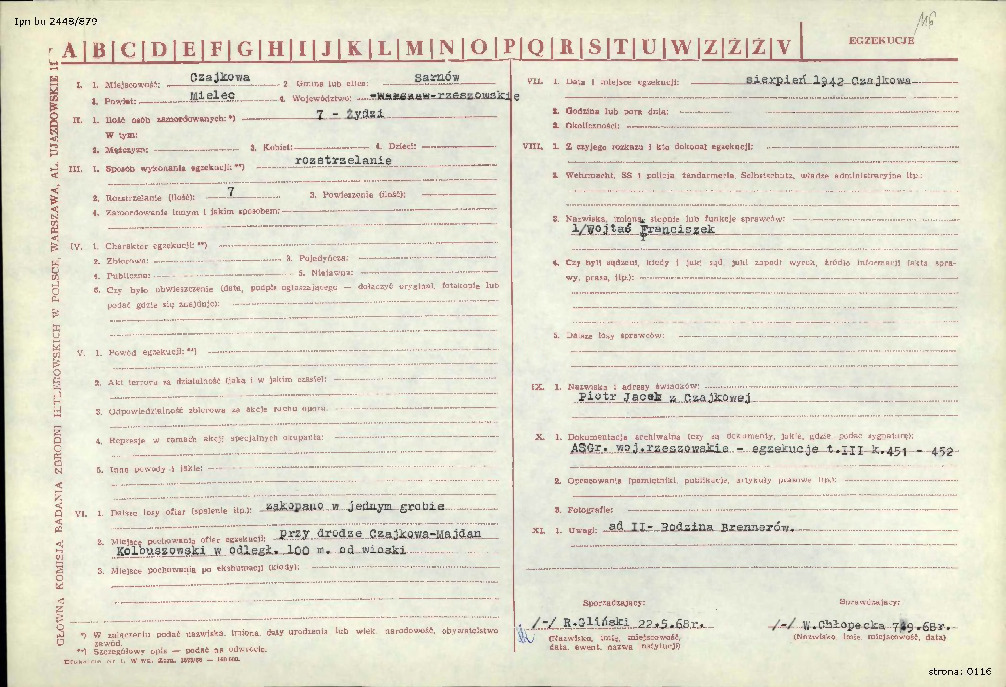 Czajkowa Ankiety Głównej Komisji Badania Zbrodni Hitlerowskich w Polsce oraz Okręgowej Komisji Badania Zbrodni Hitlerowskich Egzekucje pow. Mielec
Transkrypcje
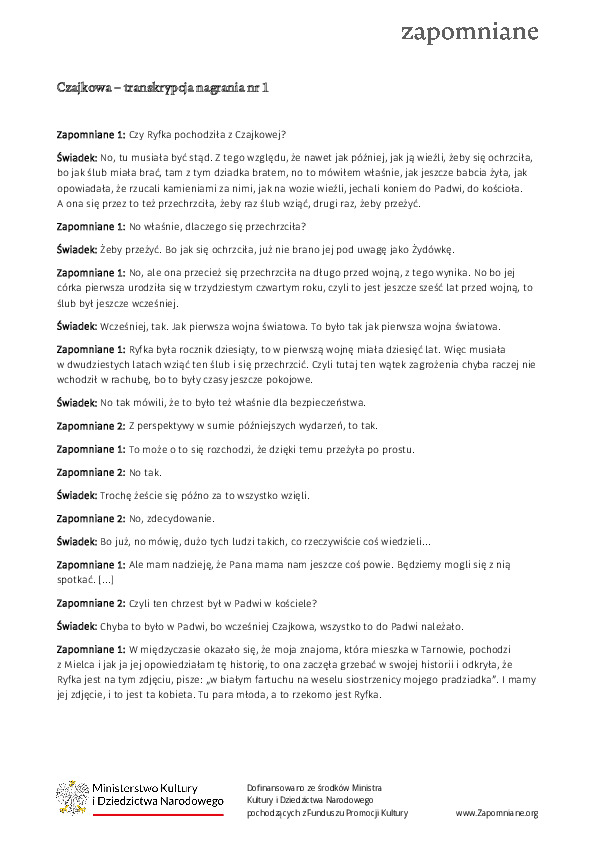 Czajkowa transkrypcja nagrania nr 1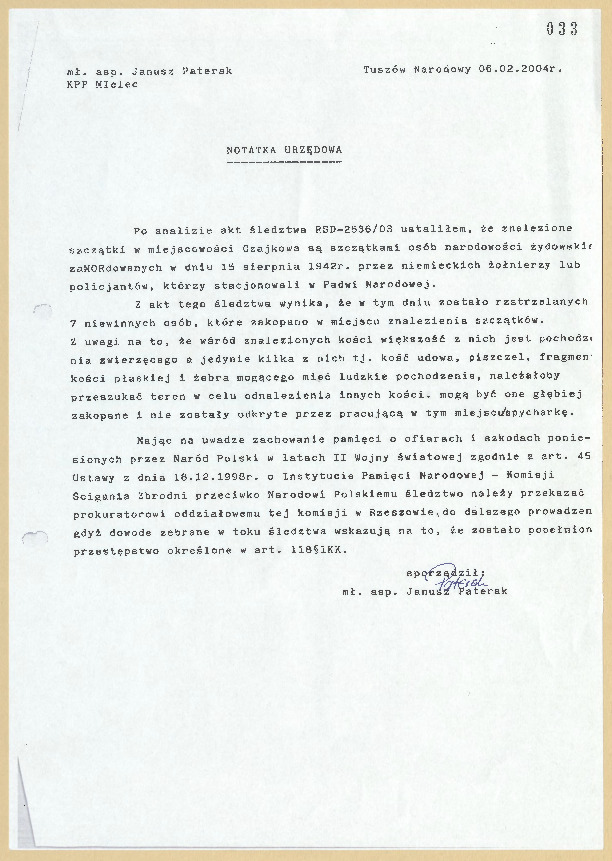
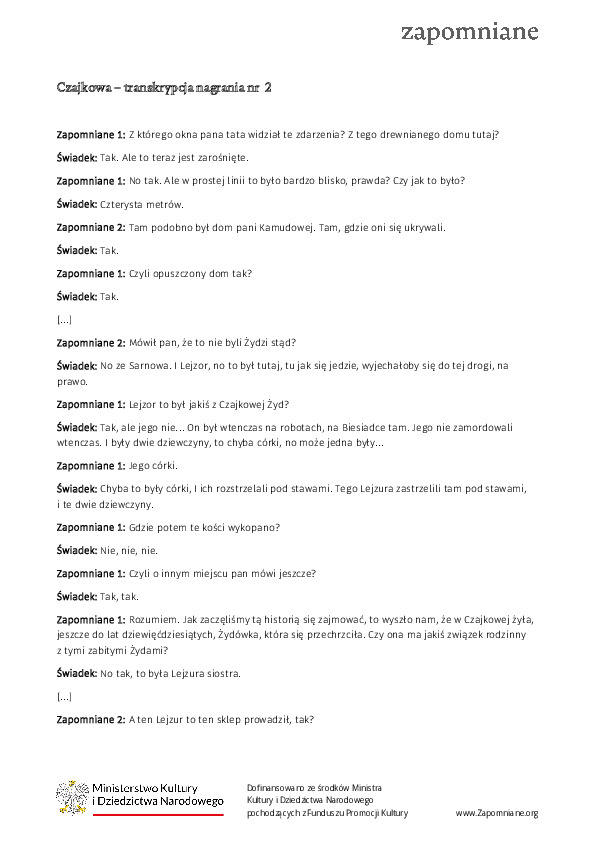
Contact and cooperation
We are still looking for information on the identity of the victims and the location of Jewish graves in Czajkowa. If you know something more, write to us at the following address: kontakt@zapomniane.org.
Bibliography
S 8/04/ZN – Investigation files regarding the murders of unidentified people of Jewish nationality on August 15, 1942, in Czajkowa.
Recording of the Zapomniane Foundation (audio file), a resident of Czajkowa, interviewed by Agnieszka Nieradko, Anna Skiba and Tomasz Sudoł. Czajkowa, August 17, 2021.
Recording of the Zapomniane Foundation (audio file), Mr. and Mrs. J., interviewed by Agnieszka Nieradko, Anna Skiba and Tomasz Sudoł. Czajkowa, March 18, 2024.
The Register of Killing Sites and Crimes committed by the Germans in Poland between 1939 and 1945, rzeszowskie voivodeshipp, Warsaw, 1984.
Aneta Dyka-Urbańska, Hałdy ziemi stały się grobem, Nowiny 24, November 26, 2003 (accessed March 8, 2025 – link)
The materials published on this website were developed, digitized, and made available thanks to funding from the Minister of Culture and National Heritage through the Culture Promotion Fund, as well as support from the Embassy of the Federal Republic of Germany in Warsaw, which also enabled the creation of the English-language version of the website.