Skierbieszów
Borough: Skierbieszów, District: zamojski, Voivodeship: lubelskieType of place
The ravine behind the buildings of the former State Machinery Centre.Information about the crime
In the summer of 2024, we carried out a site inspection of the location where Jews from Skierbieszów and nearby villages were killed during the Holocaust. The victims’ bodies were buried on site. Currently, it is a ravine filled with a huge amount of rubbish, located behind residential buildings. After the war, the State Machinery Centre was established here.
“Several executions of Jews from Skierbieszów and other villages, who were unknown to the local residents, took place in Skierbieszów. These were both individual and mass executions. Due to the lack of more precise information, they are recorded together in this questionnaire. Some of the victims were held in the local jail for several days. They were shot in the ravine on the hill, where the State Machinery Center (POM) is located today.” (IPN BU 2448/607)
“At the beginning of May 1942, the SS gave the order that at around 3 p.m., all Jews living in Skierbieszów should gather near the police station (currently a kindergarten). At around 5 p.m., the gathered Jews were led to a hill (where the State Machinery Centre is currently located) and lined up on the south-eastern slope of the hill, where there was a fairly large and long ravine (which is still partially visible today). They fired a long burst of machine gun fire at the Jews lined up there. Not all of them died immediately. After the first burst, a child could be heard crying about 300 metres away (near the church). Afterwards, single shots were heard – the Germans were finishing off the wounded. The list below does not include all victims, as some Jews were known only by nicknames and their real names could not be established. Moreover, many were from other villages, and no one knew their names.” (IPN BU 2448/607, note dated 24 October 1968)
The Jews were led to the place of execution before the eyes of the local residents, as confirmed by witness testimonies given in the 1960s before the District Court in Lublin, and by accounts recorded by us 80 years after the events.
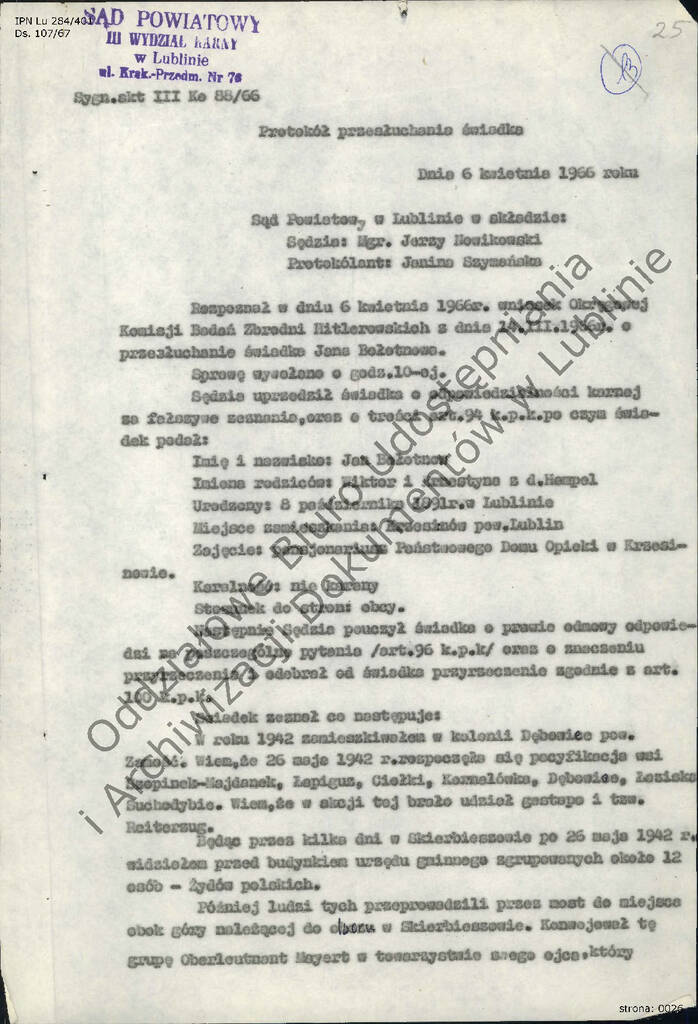
Jan B., born in 1891:
“During several days in Skierbieszów after May 26, 1942, I saw about 12 Polish Jews gathered in front of the municipal office building. Later, these people were led across the bridge to a place near the hill belonging to the manor in Skierbieszów. This group was escorted by Oberleutnant Mayert, together with his father, who had come to visit him from Berlin, and two other Germans. Later, I heard gunshots. From the group of people brought to the execution site, I knew Puter and his ten-year-old daughter, as well as Bojma, whose first name I do not remember, residing in Skierbieszów, Zamość district. I do not know the organizational affiliation of perpetrators of the murder, nor do I know where the bodies of the murdered were buried.” (testimony from April 1966)
Edward Z., born in 1912:
“In the spring of 1942, I was working at the Municipal Office in Skierbieszów, Zamość district. One afternoon, I saw a group of 4 to 5 Germans gather a dozen or so Jews in front of the municipal office, including men, women, and children. The Germans beat these people in front of the building and interrogated them about the rest of the Jewish residents of Skierbieszów. They were then taken past the park of the Skierbieszów manor and executed there. I know that the people who were killed were buried at the site of the crime. […] I know that the families of Puter, Bojma, and other and others whose names I do not remember were murdered at that time.” (testimony from April 1966)
The Register of Killing Sites and Crimes for the former zamojskie province records the following murders of Jewish residents of Skierbieszów:
– In August 1941, SS officers shot Icek Puter, aged 13, near the school
– On 14 May 1942, SS officers shot approximately 40 people in the ravine: 19 from Skierbieszów and 23 from the surrounding area:
- Bojm Abram, aged 49, merchant
- Bojm Chaim
- Bojm Icek
- Bojm Milke, aged 43
- Brandwajn Gitla, aged 28
- Brandwajn, aged 55, seamstress
- Dawidowa, aged 50
- Edelsztajn Lipa, aged 33
- Edelsztajn Maria, aged 34, seamstress
- Fajga
- Getla, aged 26
- Herszkowa Lipka, aged 30
- Herszkowa Maria, aged 32
- Herszkowa, aged 57
- Mendel, aged 18
- Motliszyn
- Puter Chaim, aged 60
- Puter Hana, aged 38
- Puter Mosiek, aged 2
- Puter Srul, aged 56
- Puter, aged 47, merchant
- Puter (wife), aged 38
- three children aged 7–14
- Szwarc, aged 50
- Tabak Ruchla
The bodies were buried at the scene of the crime.
– In November 1942, SS officers shot two Jews – a father and his daughter.
Details about some of the victims murdered in Skierbieszów can be found in the archives of Yad Vashem:
- Abram Szlomo Bojm, born in 1886 in Skierbieszów, son of Eliahu and Dobra, husband of Liba, merchant
- Eidelsztajn Marjem, born in 1910 in Skierbieszów, daughter of Szmul and Cypora
- Chaim Puter, born in 1884 in Skierbieszów, son of Szlomo and Jehudit, husband of Estera, merchant
- Puter Israel (Srul), shopkeeper, married to Chana
- Puter Chana, née Fleshler, born in Zamość, daughter of Aleksander and Sara, wife of Izrael, shopkeeper.
- Syna Puter, born in 1890 in Skierbieszów, merchant, husband of Frajda. Their children, Dwora, aged 17, Miriam, aged 13, and Szlomo, aged 10, died in Skierbieszów in 1942.
At the beginning of 2023, we recorded the account of a resident of Skierbieszów who remembers the 1942 massacre if Jews.
Zapomniane: So you know where the grave is?
“I know. We heard the shots. They brought them here and there was a depression there – not a deep ravine, but more like a hollow, so to speak. They were already taking soil from there, limestone or something. But that place is definitely still there… I just… It makes me want to cry. Two Jewish girls were in the same class with me. My neighbor and I hid behind the fence. We heard the news that they were being taken to the State Machinery Centre. There was a ravine there, and they were shot there. We were sitting there behind the fence, afraid they would notice us. They didn’t see us. I think there were two Jews left. There was one man whom they called Wunio. He had a shop, and he was hiding at Szozda’s place, near the end of the orchards – he was well-off. Did someone report him? I only remember that they led that Jew through our courtyard. He was maybe 20 years old. They took him out to a field next to our neighbour’s, under a high embankment, and they killed him there. My neighbor and I ran over to see. He was lying under that high embankment, but his shoes were gone. People said that the neighbor who lived up on the hill took off the shoes, but that may not be true. Maybe he took the shoes off himself. They buried him there under that embankment. And when they were shooting the others here, the neighbor and I only heard the shots. They killed all of these Jews.” (Sady, January 21, 2023)
Bogusław J., born in 1936, confirms that the murders of Jews took place in a ravine near the post-war State Machinery Centre:
“I heard about it. There was a ravine, and it was a road from the manor – the one that still stands in Skierbieszów. There used to be a State Machinery Centre. And there was a road there, going down to the main road. Now there is a bridge, but back then it was different. It went past the church, toward the orchards, if you’re oriented in the area. And that ravine led to the manor. And in that ravine, the German military police shot Jews. How many there were, or who they were, I don’t know. I didn’t know these Jews, and I know nothing about them. I only heard that they were shot in that ravine. And where they were buried, I can’t say either. “(Zamość, July, 2022)
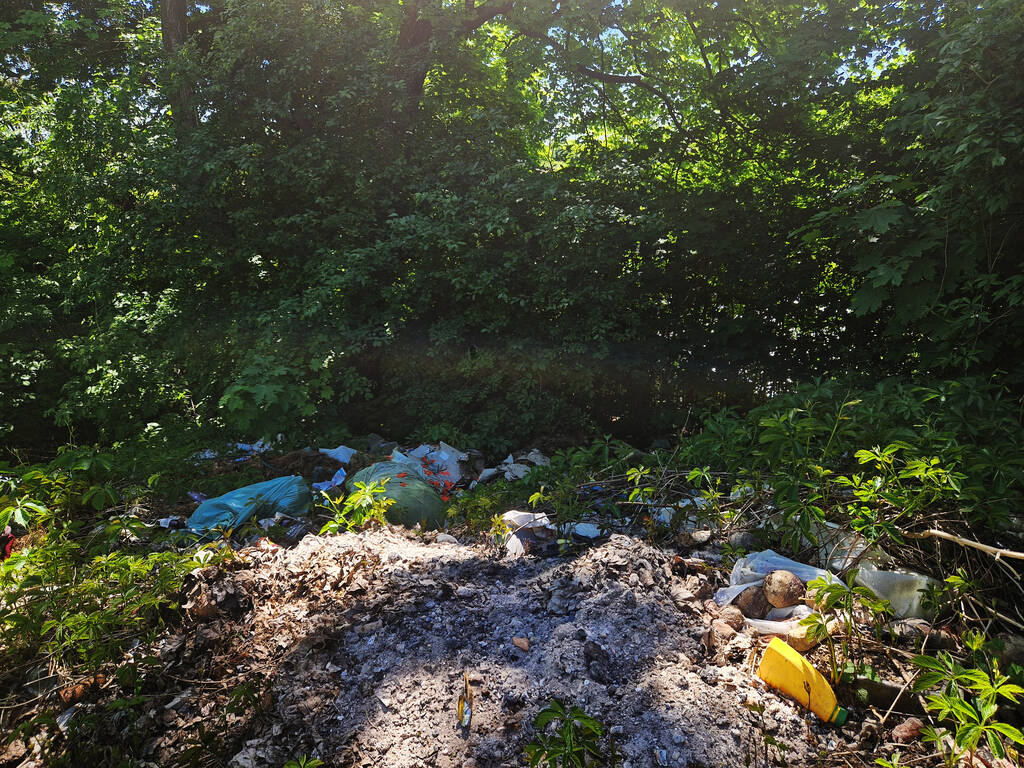 Skierbieszów fotografia lokalizacji
Sources
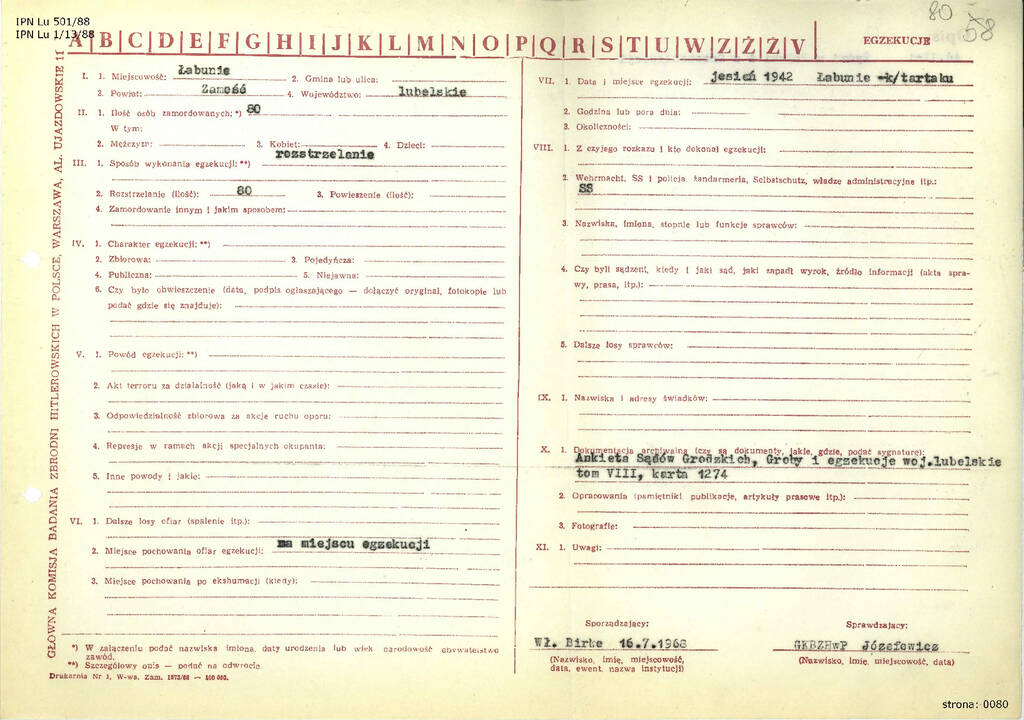
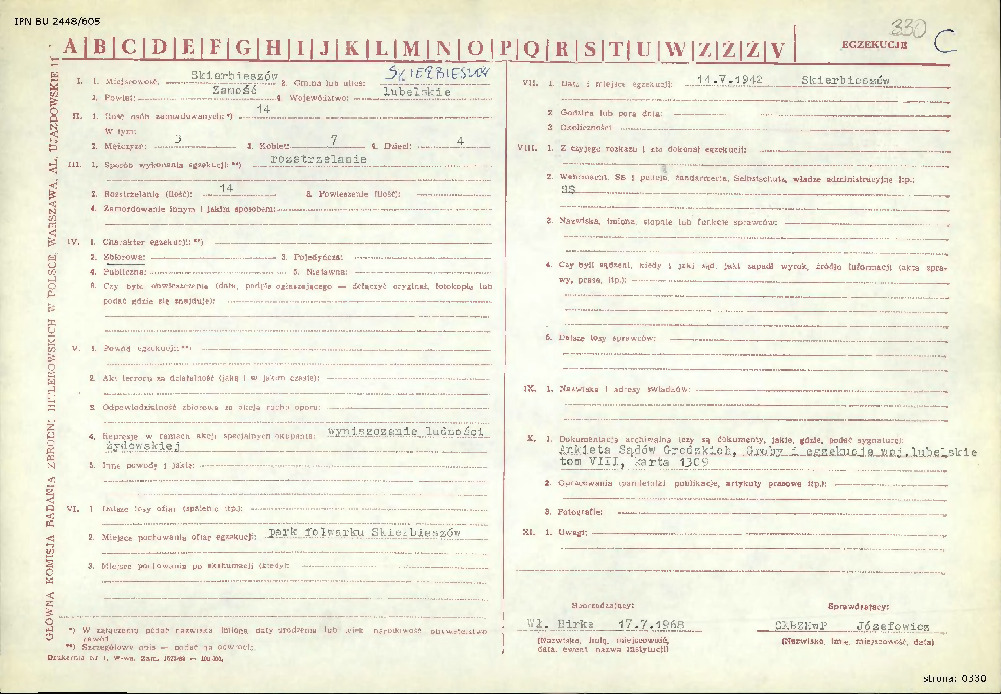 Skierbieszów Ankiety GKBZH w Polsce oraz OKBZH w Warszawie, zebrane w latach 1968-1972_4
Transkrypcje
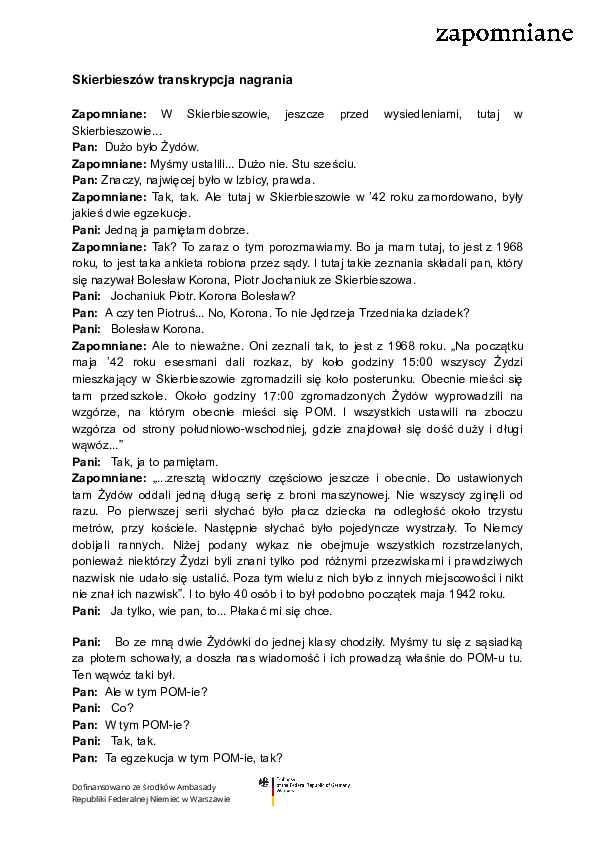 Skierbieszów transkrypcja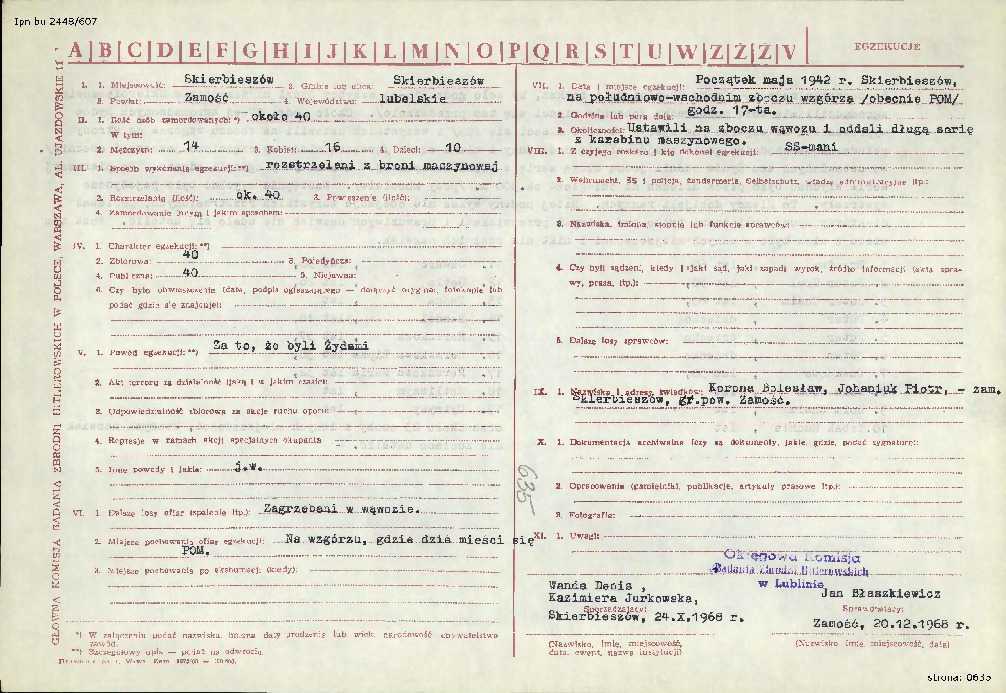
Contact and cooperation
We are still looking for information on the identity of the victims and the location of Jewish graves in Skierbieszów. If you know something more, write to us at the following address: kontakt@zapomniane.org.
Bibliography
IPN Bu 2448/607 part 2, the Chief Commission for the Examination of German Crimes in Poland, Zamość district, executions
IPN Bu 2448/605, part 2, surveys of the Chief Commission for the Examination of German Crimes in Poland, collected in 1968-1972, Surveys concerning the lubelskie -VIII, Zamość district: surveys
IPN Lu 501/88 surveys of the Regional Commission for the Examination of German Crimes in Lublin collected in 1968-1972, concerning the killing sites and crimes in the Zamość district
IPN Lu 284/401 Crimes committed by Germans in 1940–1942 against the inhabitants of Skierbieszów, Zamość district, i.e. crimes under Article 1 of the Decree of 31 August 1944.
The Register of Killing Sites and Crimes committed by the Germans in Poland between 1939 and 1945, Zamość district, Warszawa, 1994
Recording of the Zapomniane Foundation (audio file), Zofia J., interviewed by Marek Kołcon, Sady, January 21, 2023
Recording of the Zapomniane Foundation (audio file), anonymous resident of Skierbieszów, interviewed by Agnieszka Nieradko and Andrzej Jankowski, Skierbieszów, May 13, 2024
Recording of the Zapomniane Foundation (audio file), Bogusław J., born in 1936, interviewed by Marek Kołcon, July 2022
The materials published on this website were developed, digitized, and made available thanks to funding from the Minister of Culture and National Heritage through the Culture Promotion Fund, as well as support from the Embassy of the Federal Republic of Germany in Warsaw, which also enabled the creation of the English-language version of the website.