Rembertów
Borough: Warszawa, District: warszawski, Voivodeship: mazowieckieType of place
A forest.Information about the crime
As a result of an archive search at the Institute of National Remembrance, we obtained the following information about the murders of Jews in Rembertów:
- At the end of 1939, the deportation card records the murder of approximately 30 Jews (elderly and children) taken from a column of approximately 200 people. “They were led through the forest along the road to Brzozowa Droga. There they were stopped, forced to dig a pit, line up at the edge of the pit, and were shot and buried there.” (IPN Bu 2448/1167)
- On 15 April 1942, Chaim Rudnicki, born on 15 May 1987, was murdered in Rembertów. (IPN 2448/1049)
- On 19 August 1942, local German military police shot three Jews. (IPN 2448/1049)
- “In August 1942, 300 Jews were murdered on Cyrulików Street (forest). (IPN Bu 2448/1164)
- Before August 19-20, 1942, the military police from Rembertów murdered two men and a woman, Jews of unknown names, brought from outside Rembertów. The victims’ bodies were buried in a pit about 25 meters from the viaduct in the direction of Rembertów. (IPN Bu 2448/1164)
- August 19 and 20, 1942 – the beginning of the liquidation of the ghetto in Rembertów. The German military police murdered about 100 people. The murders took place on Okuniewska Street (24 people), Artyleryjska Street (12 people) and Kościuszki Street (42 people). The bodies of the victims were buried. Notes on the victims: Jews of unknown names – women, men, and children, from infants to the elderly. There was no exhumation. (IPN 2448/1049)
- During the liquidation of the ghetto in Rembertów, the Germans shot about 10 people ‘by the walls’. “People who were still half alive, including many children, were buried in pits.” (IPN Bu 2448/1158)
- On 20 August 1942, during the deportation operation in Rembertów, Judka Lejb Ajzefus, born on 15 February 1898, and Lejzor Rubin were killed. (IPN 2448/1049)
- “On 22 August 1942, during the deportation of Jews from the Rembertów ghetto, three women were shot on Żwirki Street 12: Basia Ostrzega, born on 15 February 1890, Basia Rudnicka, born in 1915, and Bajla Rudnicka, born in 1918.” (IPN 2448/1049)
- “On 31 August 1942, during the liquidation of the ghetto in Rembertów, Icek Rubin, born on 1 January 1907, and Majer Rubin, born in 1903, were shot.” (IPN 2448/1049)
- “In the summer of 1943, the labor camp and ghetto were liquidated; many Jews and a Polish family were murdered. The killed Jews were buried under the house at 11 Artyleryjska Street.” (IPN Bu 2448/1164)
- In 1943, the German military police murdered approximately 50 women and men by shooting and hanging them. Among the victims was an unknown number of Jews. The executions were allegedly for “belonging to an organization,” and for Jews, for leaving the ghetto. The place of burial was listed as “the local cemetery.” (IPN Bu 2448/1164)
- Probably in 1943, near the railway viaduct toward Mińsk Mazowiecki, the German military police murdered nine Jews of unknown names. The place of the murder was described in the survey as “one of the main places of execution; there were probably more executions there.” (IPN Bu 2448/1164)
- “In 1943, 200 Jews were murdered in a mass execution on Markietanki Street in Rembertów. At the postwar Markietanki Street (formerly Batorego Street during the war, near the training ground in the field and by the forest in front of Batorego Street), 20 people (15 men, 4 women and one child), including Jews, were also murdered by the German military police. Polish people were led out of the cinema, while Jews were captured in a street roundup. After the war, Polish families retrieved their relatives and buried them in the cemetery.” (IPN Bu 2448/1164)
- “1943 – execution of a Jewish family hiding during the liquidation of the Warsaw ghetto. Seven people were murdered, probably 3 children, 2 women, and 2 men. They lived on today’s Paderewskiego Street. The execution was carried out directly by soldiers from the SS Galizien units. It was probably the Friday before Easter. Most likely, this family was betrayed. They came for them at dawn.” (IPN Bu 2448/1164)
- In the final days of the liquidation of the Rembertów ghetto, 50 people were murdered. “I lived in Rembertów, and in 1944 I witnessed the liquidation of the ghetto. I saw the remaining Jews being hanged. Those who were ill were shot. I saw them hang 10 of the 50 Jewish hostages. I witnessed the Germans kill a Jewish woman who had a child in her arms.” (IPN Bu 2448/1164) Another witness testified: “A German tore a tiny child from a distraught mother and smashed the child’s head against a wall in front of her, then shot the woman three times.” (IPN Bu 2448/1167)
- On October 16, 1944, the Germans murdered about 10 prisoners of war, Russians and Jews, near the ammunition factory. (IPN BU 2448/1158)
- No date – Rembertów, Żwirki i Wigury Street, the Germans shot about 15 people. “Executions of Jews on Żwirki i Wigury Street, they had been captured there. First, they killed an old woman, then an elderly Jew.” (IPN Bu 2448/1164)
Sources
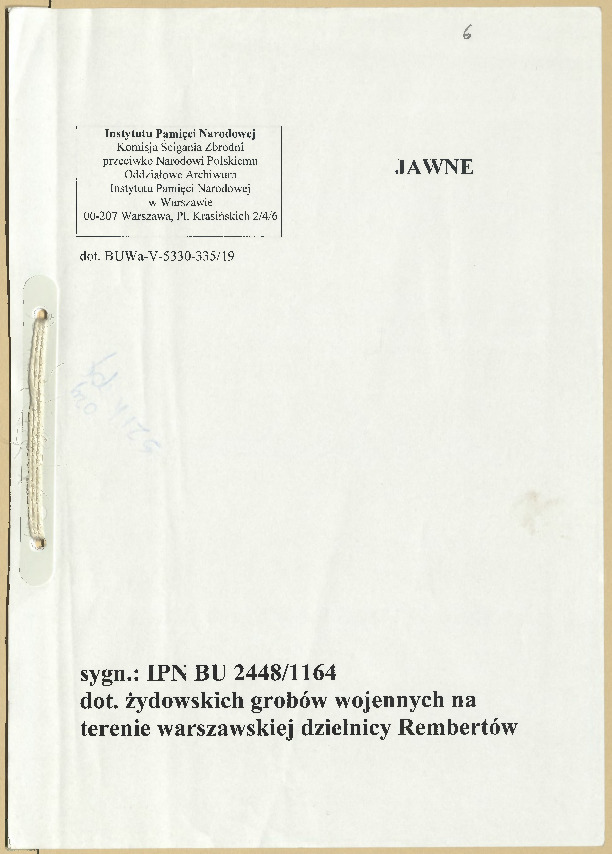 Rembertów Ankiety GKBZH w Polsce oraz OKBZH w Warszawie, zebrane w latach 1968-1972
Contact and cooperation
We are still looking for information on the identity of the victims and the location of Jewish graves in Rembertów. If you know something more, write to us at the following address: kontakt@zapomniane.org.
Bibliography
IPN Bu 2448/1047 Surveys of the Chief Commission for the Examination of German Crimes in Poland and the Regional Commission for the Examination of German Crimes in Warsaw collected between 1968 and 1972. Surveys regarding warszawskie voivodeship-XV. Warszawa district: surveys.
IPN Bu 2448/1048 Surveys of the Chief Commission for the Examination of German Crimes in Poland and the Regional Commission for the Examination of German Crimes in Warsaw collected between 1968 and 1972. Surveys regarding warszawskie voivodeship-XV. Warszawa district: surveys.
IPN Bu 2448/1049 Surveys of the Chief Commission for the Examination of German Crimes in Poland and the Regional Commission for the Examination of German Crimes in Warsaw collected between 1968 and 1972. Surveys regarding warszawskie voivodeship-XV. Warszawa district: surveys.
IPN Bu 2448/1156 Surveys of the Chief Commission for the Examination of German Crimes in Poland and the Regional Commission for the Examination of German Crimes in Warsaw collected between 1968 and 1972. Surveys of the Regional Commission for the Examination of German Crimes in Warsaw – Warsaw and surroundings-XVA. Warsaw – Praga: surveys.
IPN Bu 2448/1158 Surveys of the Chief Commission for the Examination of German Crimes in Poland. Warsaw, executions.
IPN Bu 2448/1164 Surveys of the Chief Commission for the Examination of German Crimes in Poland and the Regional Commission for the Examination of German Crimes in Warsaw collected between 1968 and 1972. Surveys of the Regional Commission for the Examination of German Crimes in Warsaw – Warsaw and surroundings-XVA. Warsaw – Praga: surveys.
IPN Bu 2448/1167 Surveys of the Chief Commission for the Examination of German Crimes in Poland and the Regional Commission for the Examination of German Crimes in Warsaw collected between 1968 and 1972. Surveys of the Regional Commission for the Examination of German Crimes in Warsaw – Warsaw and surroundings-XVA. Warsaw – Praga: surveys.
IPN Bu 2448/1169 Surveys of the Chief Commission for the Examination of German Crimes in Poland and the Regional Commission for the Examination of German Crimes in Warsaw collected between 1968 and 1972. Surveys of the Regional Commission for the Examination of German Crimes in Warsaw – Warsaw and surroundings-XVA. Warsaw – Praga: surveys.
IPN Bu 2448/1171 Surveys of the Chief Commission for the Examination of German Crimes in Poland and the Regional Commission for the Examination of German Crimes in Warsaw collected between 1968 and 1972. Surveys of the Regional Commission for the Examination of German Crimes in Warsaw – Warsaw and surroundings-XVA. Warsaw – Praga: surveys.
The materials published on this website were developed, digitized, and made available thanks to funding from the Minister of Culture and National Heritage through the Culture Promotion Fund, as well as support from the Embassy of the Federal Republic of Germany in Warsaw, which also enabled the creation of the English-language version of the website.