Łęka
Borough: Dąbrowa Górnicza, District: Dąbrowa Górnicza, a city with district rights, Voivodeship: śląskieType of place
A forest.Information about the crime
In 2023, we received a report about an unmarked grave in one of the districts of Dąbrowa Górnicza. The following entry appeared on one of the now-defunct forums of the Łazy borough, describing the situation that took place on the border between the territories incorporated into the Third Reich and the General Government during the Holocaust:
“During World War II, the area of our municipality lay in a border zone separating the territory annexed by the Third Reich from the General Government. The border ran near Ogrodzieniec, and as a result, a trail ran through the surrounding forests, which Jews from the Zagłębie region used to flee to the General Government out of fear of German reprisals. This practice was so widespread that many local residents made a “profession” out of smuggling entire Jewish families, who in turn handed over their possessions just to save their lives. Unfortunately, sometimes greed blinded the guides, who would attack the Jews in the forest, robbing them, beating them, and sometimes even killing them. There were also cases when collaborators working with the German military policemen would lead Jews to an agreed-upon location, where mass executions took place. How many nameless Jewish graves the surrounding forests conceal, we will likely never know. One such event, however, occurred in the forest between Niegowonice and Łęka in August 1943. We know about it from the account of a resident of Łęka, who, as a young boy, was forced to bury a Jewish family murdered by a German military policeman in the forest. Since the descendants of those involved in this event now live in our area, their identities remain known only to the editorial office.”
In the same year, we reached Mr. Antoni T., a resident of Dąbrowa Górnicza, who knew the story of a murdered Jewish family from his grandfather, a tailor by profession. Clients of the tailor’s shop shared stories from the recently ended war, one of which was the story of a Jewish family from Ząbkowice, murdered in August 1943.
On Sunday, August 8, 1943, during the harvest season, a Jewish family who owned a lime kiln operating before the war in Ząbkowice, three married couples: grandparents in their sixties, a couple in their forties, a young couple (the woman was heavily pregnant), and a boy aged around 10-13, the son of the middle-aged couple, were being escorted from Łosień to Łęka. Their destination was the General Government, just beyond Ogrodzieniec, where they were supposedly guaranteed safe shelter. When they reached Łęka, they stopped at Józef M.’s farm and asked him to guide them through the forest (today known as Mokrznia Forest, named after the stream running through it). They stopped for a break in the forest. The pregnant woman craved cherries and asked M. to go and pick some fruit. They gave him money to buy some food. However, instead of buying food, he went home and ordered his son to run to Łosień and inform commander Gryc about the Jews. The guides notified the German police, who murdered the entire group at the so-called “Patoka” and ordered their bodies to be moved about 300 meters further into the forest commonly called “Remby.” Residents of Łęka were called to bury the bodies: Marian Z., Stanisław K., Mieczysław K. (who showed A. Trzewiczek the location), and Czesław B. (later a local school principal).
Antoni T.’s account:
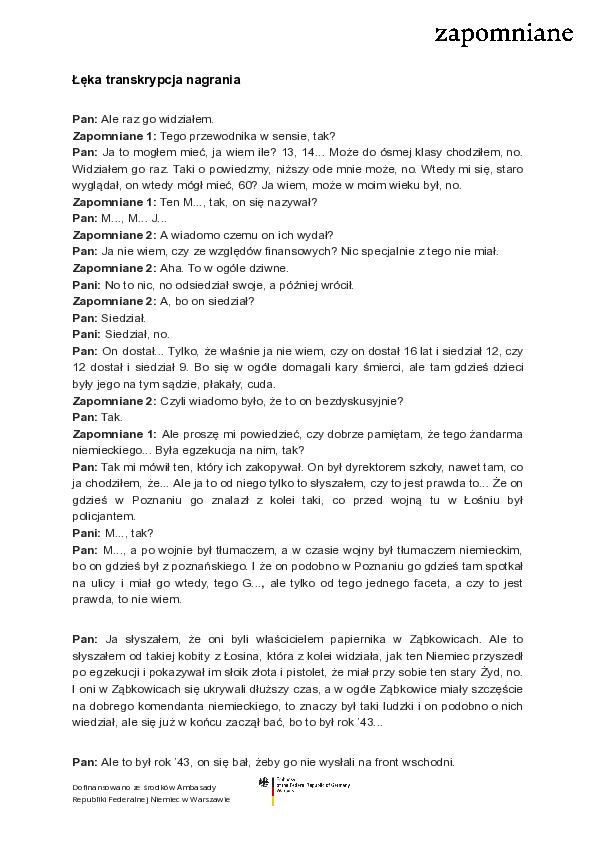
“But let’s start from the beginning, with what I know. I’m speaking as if in confession. From what I know… You see, my grandfather was a tailor, and a long time ago people used to go to the village – older gentlemen, and there were always three, maybe four of them. My grandfather would be sewing, while they sat on stools and told all sorts of interesting stories. And among other things, they were talking about these Jews, who were probably the owners, but whether that’s true or not, I suppose it could be checked. Maybe we’ll get to that later. They were said to be the owners of a lime kiln in Ząbkowice, and they stayed there until 1943, around August 8th. But Ząbkowice was fortunate to have two very kind commanders who did not harm people. One of these commanders learned about them, but didn’t want their deaths on his conscience and simply ordered them to leave, as it was already too well known that they were there. He reportedly told them to look for another place. And they somehow found one, in the General Government. The General Government was located here, near Ogrodzieniec. There was a border here, as our area was incorporated into the Third Reich. There were seven people, I think, four women, two men, and a boy, some say 11 years old, others say 12, and others say 13. A little boy was walking with them. One of the women, the younger one, was pregnant, quite far along in her pregnancy. The second woman was around forty. One of the men was older, as I heard from a lady, a very well-built man. And then they… Someone led them out of Ząbkowice, and they reached the first houses in Łęka. There was a house on the outskirts. I don’t know if they went inside. The guy’s name was Józef M. And he led them to the forest. Actually, he even brought them onto his own plot, because people had small plots in the forest. He guided them there while they walked, but since it was a long walk and the woman was seven months pregnant so, of course, they had to take a break. It was cherry-picking season, and she had a strong craving for some cherries. Perhaps she wanted other food as well, I can’t really say. But among other things, she wanted cherries. So he went. He was certainly given money to bring some food and those cherries. Instead, he went home, where his son was… He had two sons, I think, and daughters, I don’t know, but he had a son who worked in the mine. I remember him; he worked in the mine. He came and told him to go, either by bike or on foot, to Łosień, to the commander, whose name was G. He was Silesian, he spoke German even better than Polish.
So that commander, without even changing clothes since it was Sunday, took another policeman with him and they went there. The Jews were sitting under a bush, under a hazel. He shot the first of the men, and at the end, the Jewish woman, the one who was pregnant.” (March 31,2023)
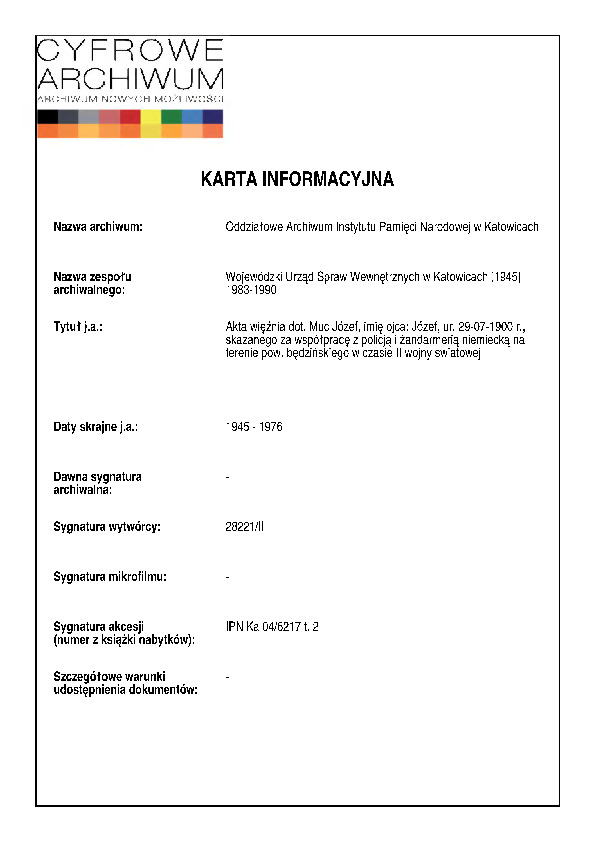
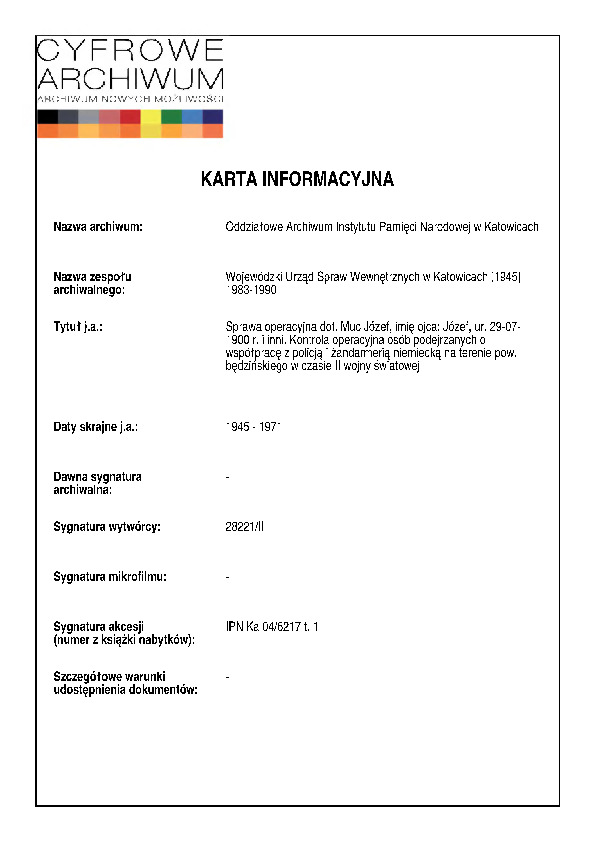
After the war, Józef M. was brought before the court, accused of “collaborating with the German occupation authorities in August 1943 in Łęka as an informant for the secret German police, acting to the detriment of those persecuted by the occupation authorities by notifying the German police and indicating the location in the forest where the Jews were hiding, as a result of which eight Jews were immediately captured and shot.” On August 19, 1946, Józef M. was sentenced by the Special Criminal Court in Katowice to twelve years in prison. (IPN Ki 4/6217)
Commemoration
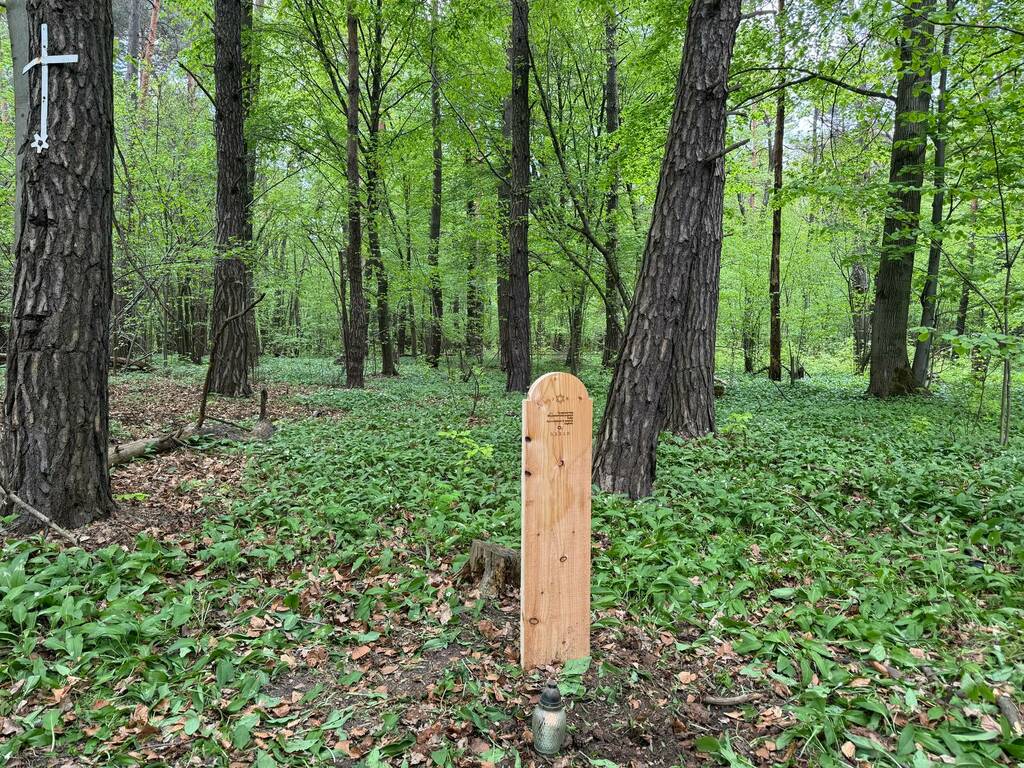
The place of the grave was marked with a wooden matzevah in 2025 as part of the project: “Reference points. Creating wooden Matzevot with the local community.”
The project is an attempt to find a way of marking these places before they can be commemorated. Marking forgotten Jewish war graves with wooden matzevot is a subtle intervention in the landscape reminding about what remains invisible, yet present in the memory of local communities. Being only a temporary commemoration, wooden matzevot invite local communities to discuss and take action, to discover the places, and perhaps to start their own memory practice related to them or to initiate a permanent commemoration.
You can read more about the project here: link
The project “Reference points. Creating wooden Matzevot with the local community” was implemented thanks to the funding from The Association of the Jewish Historical Institute of Poland (Stowarzyszenie Żydowski Instytut Historyczny).
IDENTIFICATION OF THE GRAVE BASED ON NON INVASIVE RESEARCH
On August 19, 2024, a site inspection was carried out at the precisely indicated location (GPS: N 50°22.846′ E 019°22.202′), identified as the site of a mass grave. During the inspection of the area, tests were carried out using ground-penetrating radar (MALA X3M/500 MHz). Six profiles, labeled LEK10001–LEK10006, were collected. Echogram LEK1 shows disruptions in soil layers at the site identified as the mass grave location. Soil layers have been disturbed at a depth of approx. 2.40 m – approx. 6.0 m. The estimated dimensions of the grave are about 1.80 m by 3.60 m with a depth of approx. 0.9 – 1.0 m below ground level (The clearly visible disturbances in the form of a strongly blurred image on the profiles are probably caused by electromagnetic noise in a frequency range close to that of the ground-penetrating radar antenna. There may be a local source of interference. However, these results should not be linked to anomalies caused by the objects being searched for.).
The aerial photography query for this area wasn’t ordered.
The terrain measurement (LiDAR) is not helpful in this case.
 Łęka fotografia satelitarna 1a
 Łęka fotografia lokalizacji 1
 Łęka LEK10001
Sources
 Łęka Akta więźnia dot. Muc Józef, imię ojca_ Józef, ur. 29-07-1900
Transkrypcje
 Łęka transkrypcja nagrania




Contact and cooperation
We are still looking for information on the identity of the victims and the location of Jewish graves in Łęka. If you know something more, write to us at the following address: kontakt@zapomniane.org
Bibliography
IPN Ka 04/6217 vol. 1 and 2, Operational case concerning Józef M., father’s name Józef, born 29 July 1900, and others. Operational surveillance of individuals suspected of collaborating with the police and German military police in będziński district during the World War II.
Recording of the Zapomniane Foundation (audio file), Antoni T., interviewed by Agnieszka Nieradko, Dąbrowa Górnicza, March 31, 2023.
The materials published on this website were developed, digitized, and made available thanks to funding from the Minister of Culture and National Heritage through the Culture Promotion Fund, as well as support from the Embassy of the Federal Republic of Germany in Warsaw, which also enabled the creation of the English-language version of the website.