Krzywowólka
Borough: Sławatycze, District: bialski, Voivodeship: lubelskieType of place
Forest, horse cemetery, plot no. 135 in Krzywowólka, Sławatycze borough, bialski district.Information about the crime
In January 2024, we visited Krzywowólka in the borough of Sławatycze, where we searched for the burial site of a Jewish woman murdered in 1944. After being expelled from her home, Brandla lived with her daughter at her neighbors’ house. When the persecution of Jews intensified, they separated. The mother hid in an abandoned Ukrainian house, while the daughter found refuge with a Christian family and survived until the end of the war.
One of the villagers informed us about the existence of the grave in Krzywowólka. It was also thanks to his help that we got in touch with Mr. Franciszek Z. (born in 1927), who knew the murdered woman and her daughter. In the same year, we recorded Mr. Franciszek’s testimony, in which he recounts the death of the mother and the survival of the daughter, Lola:
Franciszek Z.: It was a Jewish family. The father of the family was a miller and had his own windmill. He had a wife, Binefowa, but at least I have no further information about her. And there was one daughter, named Lola.
Zapomniane: Was that her name?
Franciszek Z.: No, no. I mean, yes, the father’s name was Binef, the wife’s name was Binefowa, and they had a daughter, Lola.
Zapomniane: But was that her name?
Franciszek Z.: Yes.
Zapomniane: Did her mother also call her that? Do you remember?
Franciszek Z.: Yes, yes, that was her official name. That said, I don’t officially know the surname of Binef or his wife, but I tried to find out and found a man named Binesz Liberman, a miller, in the registry office in Sławatycze. And I just associated it, since in the village people commonly called him Binef, but it’s most probably Binesz Liberman, born probably in 1906, early in the century. […] As for the name of the place where Binefowa was buried, it is called horse graves. I mean, it is commonly known as horse graves, not a horse cemetery, because that somehow conflicts with itself. A cemetery is intended…
Zapomniane: For people.
Franciszek Z.: For people, whereas it was such a place… Perhaps I should also explain its origin. Before the war, there was what was known as glanders. And a lot of horses died. There were cases when a horse was already… Of course, there was no treatment. The horses were taken to an isolated place, and they were either put down there or left to die, and that’s where they were buried. That’s where the name comes from; I would suggest using the name “horse graves”. […] The Binefs had only one daughter, Lola. I must emphasize here that she was three or four years younger than me, but I often visited the windmill because my dad had a large farm there and needed to grind grain for feed and other purposes. And that windmill was really fascinating for me. I don’t know if you’ve ever had the chance to see it, but there are these big gears there, and everything rotates. It’s a whole mechanism that, for me as a twelve-year-old, ten-year-old, was something very interesting and I had never encountered it before. That’s one thing. I used to spend time there, and of course, I knew Lola well, even before that period…
Zapomniane: Did you go to the same school?
Franciszek Z.: No, she was younger, and she went to Sajówka. She didn’t go to Krzywowólka. I don’t know why, but she lived, so to speak, between Krzywowólka and Sajówka, closer to Krzywowólka, yet for some reason she went to school there. I even had a friend from Sajówka who recently passed away, who also remembered her well from her school days. I have to say that the father, Binef, had Jewish features; he was tall, very dignified, calm, kind and very good with people. Binefowa was short, jet-black, I remember, with a black braid, very lively, energetic – she seemed to rule the whole family. She was a seamstress, and all the housewives and girls there used her services. Blouses, skirts, and other clothing, they were all made by her. Well, she had… They both were… They were very well thought of by the people. They were exceptionally kind…
Zapomniane: And was that the only Jewish family in Krzywowólka?
Franciszek Z.: Yes, if I remember correctly, it was the only one. They lived about half a kilometer from the village. The windmill was in a secluded spot, so to speak, with no buildings getting in the way.
Zapomniane: I know that Mr. Piotr Lasota from Brama Grodzka in Lublin visited you.
Franciszek Z.: Yes.
Zapomniane: Last year. I listened to the recordings of your conversations, and in one you mentioned that the Binefs had some children who died in childhood. Is it true that Lola had siblings she didn’t know, or who passed away as children?
Franciszek Z.: I mean, I have to say that maybe at some point… But unfortunately, my memory, naturally with age, is a bit fading right now, and…
Zapomniane: You don’t remember that now?
Franciszek Z.: I don’t recall them having more children. [Agata Romaniuk, who spoke with Franciszek Z. a few years before us, writes in her article: “The Liebermans had three children, but two sons died early.”] As far as I know, Lola was their only daughter. I remember her from childhood, because it wasn’t far, and all the children there knew each other. We would meet on various occasions. […] When Lola left our house, the image of her leaving is still vivid in my mind. Really. She leaves the house, and there was a ditch by the house. She walks along a little path, over a footbridge across the ditch, onto the road, and then disappears along the road toward Tuczna.
Zapomniane: So you watched her leave?
Franciszek Z.: Yes.
Zapomniane: And how did she react then? Did she cry when she was leaving you?
Franciszek Z.: At that time, I didn’t realize what a tragedy it was.
Zapomniane: Did she know?
Franciszek Z.: She probably didn’t really realize it either. And the way she left our home went like this: Leon S. was the village administrator in our colony. He was supposedly Polish, but his surname was of German origin and he was very favorable…
Zapomniane: Towards the Germans.
Franciszek Z.: Towards the Germans, yes. Very favorable. And I don’t know if it was his initiative or not, but he brought my father a letter from the police station in Tuczna saying that he had to deliver both Jewish women to the police station in Tuczna immediately. At that time, the whole village and the whole colony knew the story, because both Jewish women were looking for a place to stay in various places, and they were in Zańków, in Krzywowólka, staying in some corner for a while, they didn’t have…
Zapomniane: And why couldn’t they be at home? Did someone take over the house?
Franciszek Z.: No, they were kicked out of the house.
Zapomniane: Who kicked them out?
Franciszek Z.: Germans. And it was quite early, I’m not sure if it was in 1939 or early 1940.
Zapomniane: And they were supposed to go to the ghetto? Were they supposed to move to the ghetto in Sławatycze?
Franciszek Z.: No. They had to leave the house and had nowhere to go, so at first, as far as I remember, they found temporary accommodation in Zańków with the N. family. Binef, not having the means to live, found work in the Tuczna borough, where he worked as a stoker or something like that… He helped out just to get a little money for himself, as one had to survive. Sadly, he died soon, from some nasty illness, as I remember. And the two women wandered from place to place. My mother, our parents, had a lot of contacts, and somehow Binefowa and her daughter established contact with our family. My mother, I don’t usually say anything bad about my mother, but she really was the kind of person who sympathized with people and helped people. She was, in a way, part of that group leading the local community. And so… she let them stay in our house. We had a fairly large house for those times, even though it wasn’t finished yet. It had three rooms, a kitchen, a pantry, a cellar, and one room that wasn’t finished yet, but it had windows, and everything… I don’t know what the floor was like, what condition it was in. And the mother and daughter took that one room, and together, as we’re sitting here – I don’t know if it’s still the same place – we welcomed them to the table. Our family was large, there were probably seven of us at that time. No, six, because our youngest sister was born a little later. We ate together and spent time together. Of course, the mother, Binefowa, and Lola helped us on the farm as best they could. But they couldn’t, because Binefowa had nothing to do with farming at all. She was a seamstress, so she really struggled with farm work and other chores, as I remember, but she wanted to, she had good intentions to repay the favor somehow.
Zapomniane: How long did they stay with you?
Franciszek Z.: It was from spring until around September. They stayed with us throughout the summer, as far as I remember. And then, at the end of that summer, the village head gave my dad the responsibility of delivering them. It was an unpleasant situation, because we had to find a solution. As I said, they were both well-known, and everyone knew they were staying with us. Hiding them… There was no way to do it. There simply wasn’t. And they agreed that they had to leave our house. Binefowa left first, in the evening, late in the evening, that is. At that time, there were many empty buildings in Krzywowólka, abandoned by Ukrainians. There were situations when they left somewhere, I don’t remember exactly where. The area was empty, with barns and empty cowsheds, and Binefowa hid in those buildings, changing her hiding place from time to time. Lola stayed overnight and, in the morning, before noon, I remember, she left with a small bundle, because back then nobody used bags or suitcases; those only became common after the war. And she disappeared with that bundle. The war was tough. And this matter – the tragedy of the Jews – somehow, in our family and beyond, was partly forgotten, partly never fully acknowledged. (Warsaw, March 2024)
After the war, Lola, now under a different name, gave the following account:
“During the Nazi occupation, my family and I were persecuted because of our Jewish origins. I lived with my parents in the village of Krzywowólka in the district of Biała Podlaska. In 1940, my father fell ill with typhus and was taken to a makeshift hospital in the village of Tuczna. This hospital was under German supervision. My father soon died in this hospital. My mother and I had to go into hiding. It was 1942 when the extermination of the Jewish population in the villages and towns of Podlasie began to intensify. At first, we hid in the village of Zańków at T.’s house. Then I had to part with my mother. We hid separately. […] My mother, as I was told after the liberation of Podlasie in 1944, was shot by the Nazis.”
In her article, Agata Romaniuk quotes the account of Antoni Ł., an eyewitness to the murder of a seamstress from Krzywowólka:
“I was getting ready to go to the forest for firewood,” he recalls. “I peeked out from behind the barn, and here comes the Ukrainian police. And the village headman. And a woman. In a strange coat, a shabby dark one. I look – and I recognize her. It’s that Jewish woman, the seamstress, who has sewn shirts for me many times. I used to go to her for custom-made clothes. She was an elegant woman, and now she’s in that shabby coat. I stopped the horse. The policeman pushes her and says, ‘Run to Rozbitówka.’ But she doesn’t want to, she resists. So he pushed her off the road onto the pasture. The other one was standing there with a rifle. Both of them were shouting, and she started to walk a few steps. Slowly. And then he shot, but he missed, and she didn’t react. She didn’t start running, she didn’t stop, she kept walking. He shot again. She didn’t fall, she just sat down. He came up to her and shot her while she was sitting, twice. […] Binefowa didn’t lie on the road for long. People took pity on her. Paweł B. took her to the edge of the village, to the horse graves.” (Lola idzie w świat, “Pismo. Magazyn opinii”, 04/2020)
During archival research, it was established that the murdered woman’s name was Brandla Liberman. She was the wife of Binym Liberman (born April 6, 1900, in Zalesie, Piszczac borough, parents’ names Mejlach and Estera, née Pocztaruk), a miller from Krzywowólka. The Tuczna municipal registry records that Binym and Brandla were married on October 13, 1938, in the Piszczac synagogue district. It seems unlikely they married so late; it’s possible that this was the date of the registry entry. They lived in Krzywowólka at number 78.
Brandla’s body was buried in the so-called horse cemetery, an area that has been dug up many times over the years, making it difficult to identify the exact location of the burial site.
Commemoration
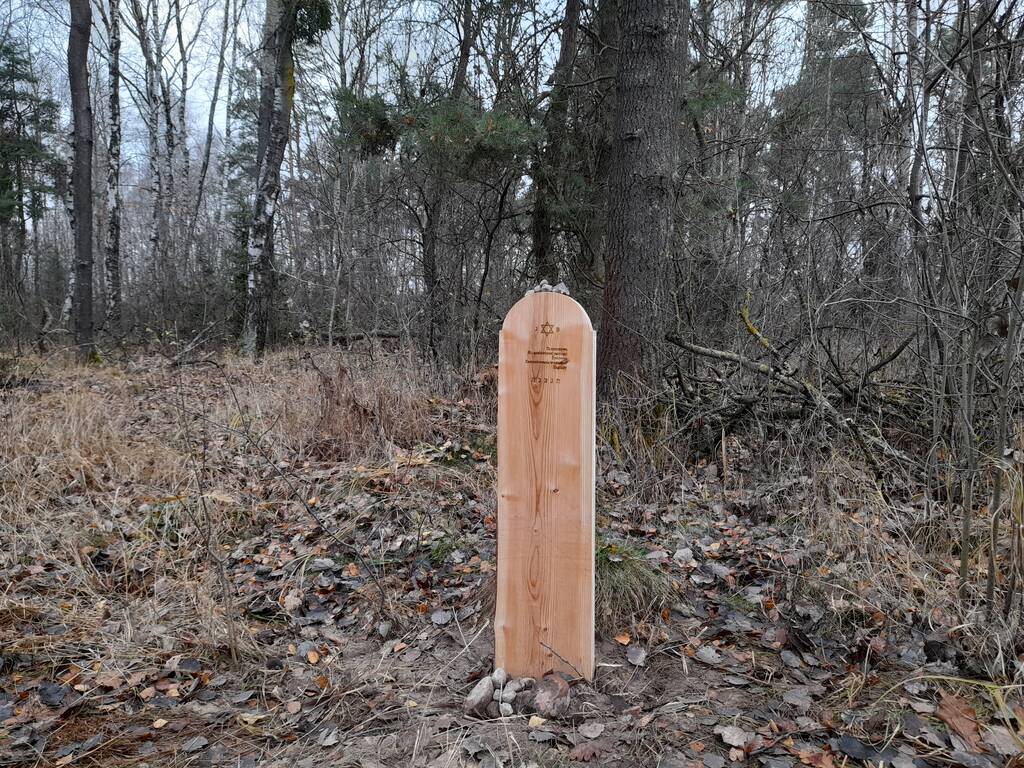
The place of the grave was marked with a wooden matzevah on 27 November 2025 as part of the project “Reference points”.
The site was marked as the result of workshops held together with the youth from the school complex in Sławatycze. During the meeting, the participants prepared a wooden marker, which we used to mark the burial site of a single Jewish woman in the forest in Krzywowólka. Prior to this, the site had remained invisible and unmarked in the landscape.
“Reference points” is an attempt to find a way of marking these places before they can be commemorated. Marking forgotten Jewish war graves with wooden matzevot is a subtle intervention in the landscape reminding about what remains invisible, yet present in the memory of local communities. Being only a temporary commemoration, wooden matzevot invite local communities to discuss and take action, to discover the places, and perhaps to start their own memory practice related to them or to initiate a permanent commemoration.
The workshop was part of the international project “MultiMemo. Multidirectional Memory: Remembering for Social Justice,” funded by the European Union under the CERV programme.
You can read more about the project here: link

 Krzywowólka zdjęcie lokalizacji
Sources
Transkrypcje
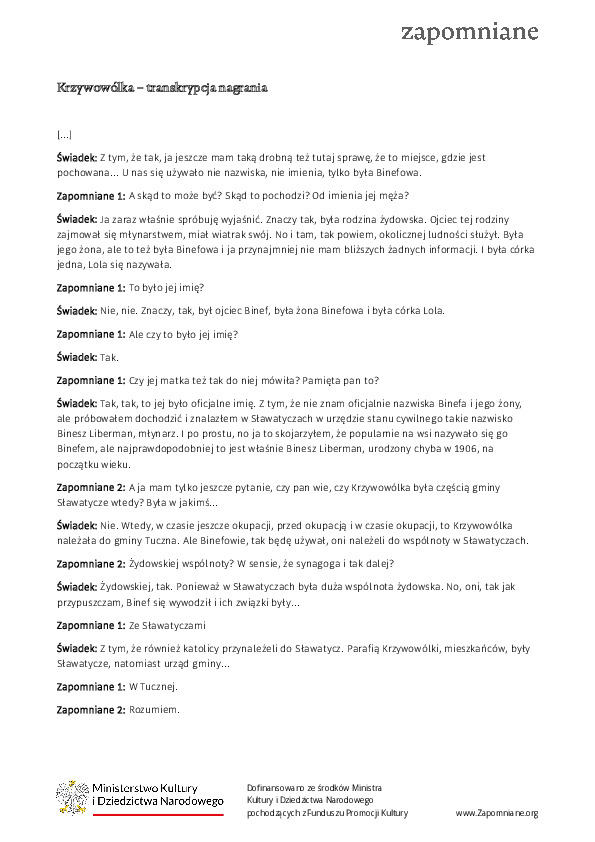 Krzywowólka transkrypcja nagrania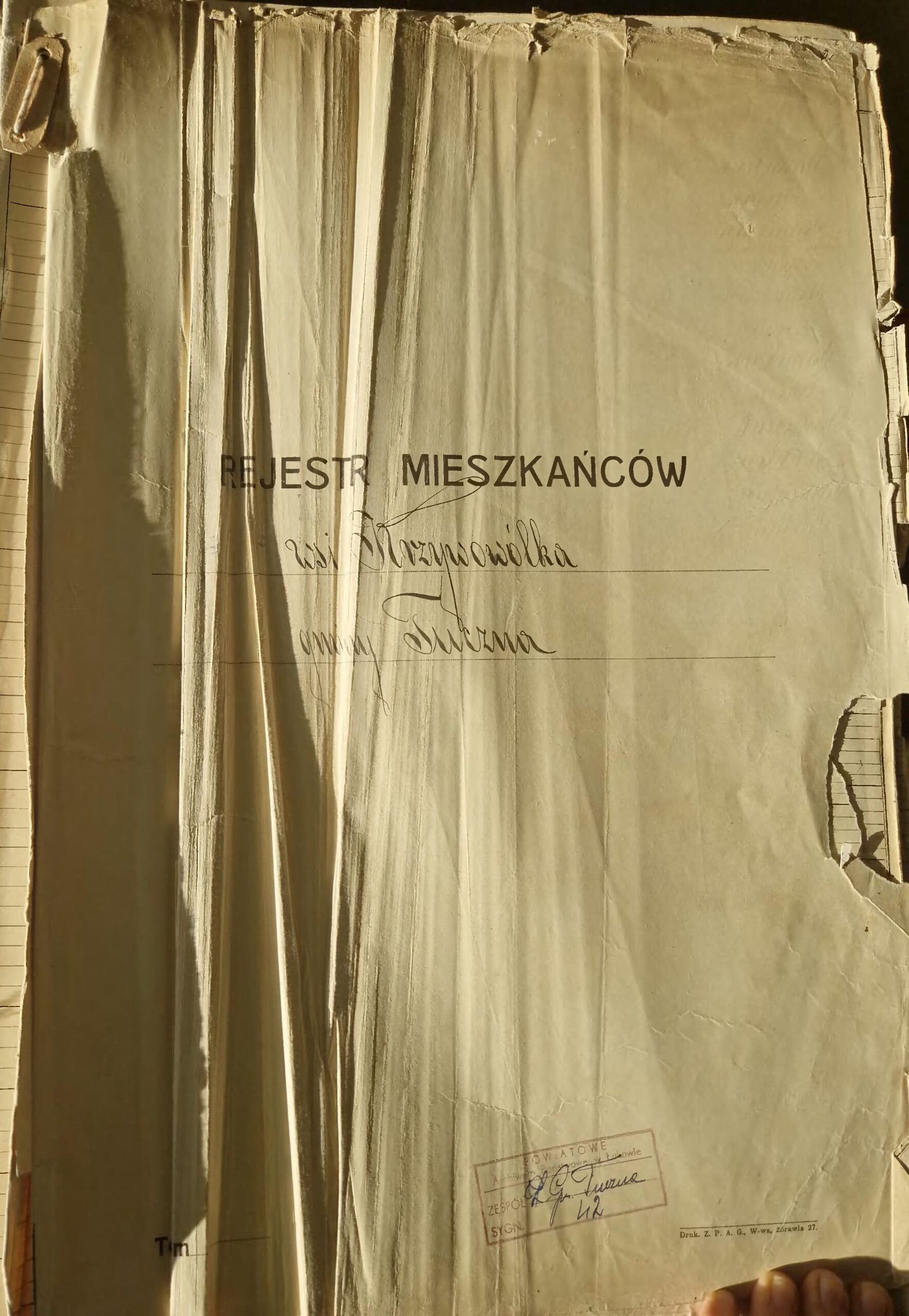
Contact and cooperation
We are still looking for information on the identity of the victims and the location of Jewish graves in Krzywowólka. If you know something more, write to us at the following address: kontakt@zapomniane.org.
Bibliography
Register of residents of the village of Krzywowólka, volume II, 1933, 38/46/0/-/42, State Archives in Lublin, branch in Radzyń Podlaski
Romaniuk A. Lola idzie w świat “Pismo. Magazyn opinii” (04/2020)
Zbrodnie Hitlerowskie w Powiecie Biała Podlaska w latach 1939-1944, Society of Friends of Science in Międzyrzec Podlaski, Międzyrzec Podlaski, 1971
Recording of the Zapomniane Foundation (audio file), Franciszek Z., interviewed by Agnieszka Nieradko and Andrzej Jankowski, Warszawa, March 2023.
The materials published on this website were developed, digitized, and made available thanks to funding from the Minister of Culture and National Heritage through the Culture Promotion Fund, as well as support from the Embassy of the Federal Republic of Germany in Warsaw, which also enabled the creation of the English-language version of the website.