Kamieńczyk
Borough: Wyszków, District: wyszkowski, Voivodeship: mazowieckieType of place
A meadow at the edge of the forest - once a clearing in the forest for overhead power line poles.Information about the crime
In 2023, we received a report from the Regional Commission for the Prosecution of Crimes against the Polish Nation in Warsaw regarding an unmarked grave of Holocaust victims in wyszkowski district. The report was submitted by the grandson and son of an eyewitness to the execution of a group of Jews in the forest near the village of Kamieńczyk In his testimony, given in February 2024 before the prosecutor of the Regional Commission, we read:
“My father didn’t remember the details clearly, but it could have been in the winter of 1942 or 1943. One day, a group of men in uniforms arrived, armed with long weapons. My father called them Germans, though I don’t know which formation they belonged to. Among them was a translator who communicated with my grandfather, my father, and his brother. The Germans ordered my grandfather, my father, and his brother to go with them. Along with them, the Germans took several men from the W. neighbors. Men from Rafa also joined this group. […] They walked eastward along the road toward the Bug River. […] My dad told me that the Germans knew where they were going, they knew that area of the forest. Dad described that in order to get to the place where the Germans were leading them, they had to walk east towards the Bug River for about 400 to 600 meters and then turn north towards Rafa, walking the same distance. When they got there, they saw a dugout covered with rags and branches. Dad didn’t mention any snow. The soldiers surrounded the shelter in a half-circle, and the translator ordered the people inside to come out. The translator continued speaking in Polish. The first to come out was a woman my father called “Mrs. Fajbusiowa”. She was Jewish. My dad knew her because he had met her at the bakery on his way home from school before the war. She used to give children buns. When she came out, the soldiers shot her. The translator ordered the next person to come out, and the soldiers fired again. The translator killed at least two people. Dad called him the devil incarnate. He was very agitated. When no one else came out at his command, the translator ordered my father to go inside. He gave him a flashlight. Dad went inside, but no one else was there. Dad didn’t say how many people had been shot. When I read the investigation information to him, he was surprised it listed only 13 people. Dad said that the Germans killed Jews there. I don’t know what gender the others were, but I understood that there were also teenagers there. Some of them may have been his peers. Dad didn’t know anyone else. From his description, the dugout was rectangular. Once all the Jews had been killed, the translator ordered a pit to be dug nearby, into which all the murdered were placed. […] I heard this story from my father before his death in December last year [2023]. He wanted someone to know about it. I asked him why he had only told me now, and he replied, “Those were foolish times. […] As far as I know, the place where the Jews died was never exhumed.” Dad said something like “they are still there”. (February 19, 2024)
In October 1945, Edward Sokalski, mayor of the borough of Kamieńczyk, testified before the district court in Wyszków that a group of 13 Jewish men and women had been murdered on February 18, 1943, by members of the German forest guard. The bodies were buried on Babia Góra near Kamieńczyk, behind the Liwiec River, by the road leading to the meadows known as Dąbrówki. According to Sokalski, the bodies of the murdered Jews were thrown into the bunker in which they had been hiding, measuring 4 by 3 meters.
In prewar Kamieńczyk lived Faibl Auslendar, born in 1896, a merchant by profession. Testimonies submitted to Yad Vashem indicate that he had at least three brothers, who were also merchants. A surviving member of the Auslander family testified in 1953 that Faibel was killed in Auschwitz in 1942.
In June 2024, we met with Zbigniew, a descendant of eyewitnesses to this murder, and members of his family. Our interlocutors were unable to indicate the area where the bunker in which the murdered Jews were buried was located. A significant breakthrough in the case was the meeting with Mr. Sylwester K. (born 1961) in June 2025. Mr. K. is a resident of Kamieńczyk and has lived in this village his entire life. The K. family were farmers who owned land in the forest near the Rafa colony. We met with Mr. K. on two occasions. During our first meeting, he showed us the locations of the “bunkers,” i.e., dugouts, which he remembered from his childhood walks through the forest while herding cows. He emphasized that at that time, the forest had no undergrowth and everything was more visible. Mr. K. identified the bunkers by their funnel-like shape – the narrower part was supposed to be the entrance to the hideout. In addition, he led us to the so-called “spring,” that is, a place in the forest where there was standing water (it was still there in the 1980s) During our first meeting (June 30, 2025), he claimed that he did not know the burial site of the Jews and only showed me the above-mentioned locations, but admitted that his father knew that the Jews were hiding on his property and that their bodies were buried near the hiding place. During the second meeting, in August 2025, Mr K. recalled that his father had told him that Jews were buried in a place known as “the corner”, on a plot of land that now belonged to Mr K. During the war, there was a cultivated field there, surrounded by forest. According to Mr. K., the location was probably chosen because it was not possible to dig a sufficiently large and deep pit in the forest without hitting tree roots with a shovel.
IDENTIFICATION OF THE GRAVE BASED ON NON INVASIVE RESEARCH
The presumed location of the grave, indicated by the owner of the plot, is situated near the boundary of plot no. 1314. The LiDAR terrain image shows a depression running parallel to the property boundary for approximately 10 meters. A large oak tree, standing out among the pines, serves as a reference point to identify the so-called “corner,” the presumed burial site.
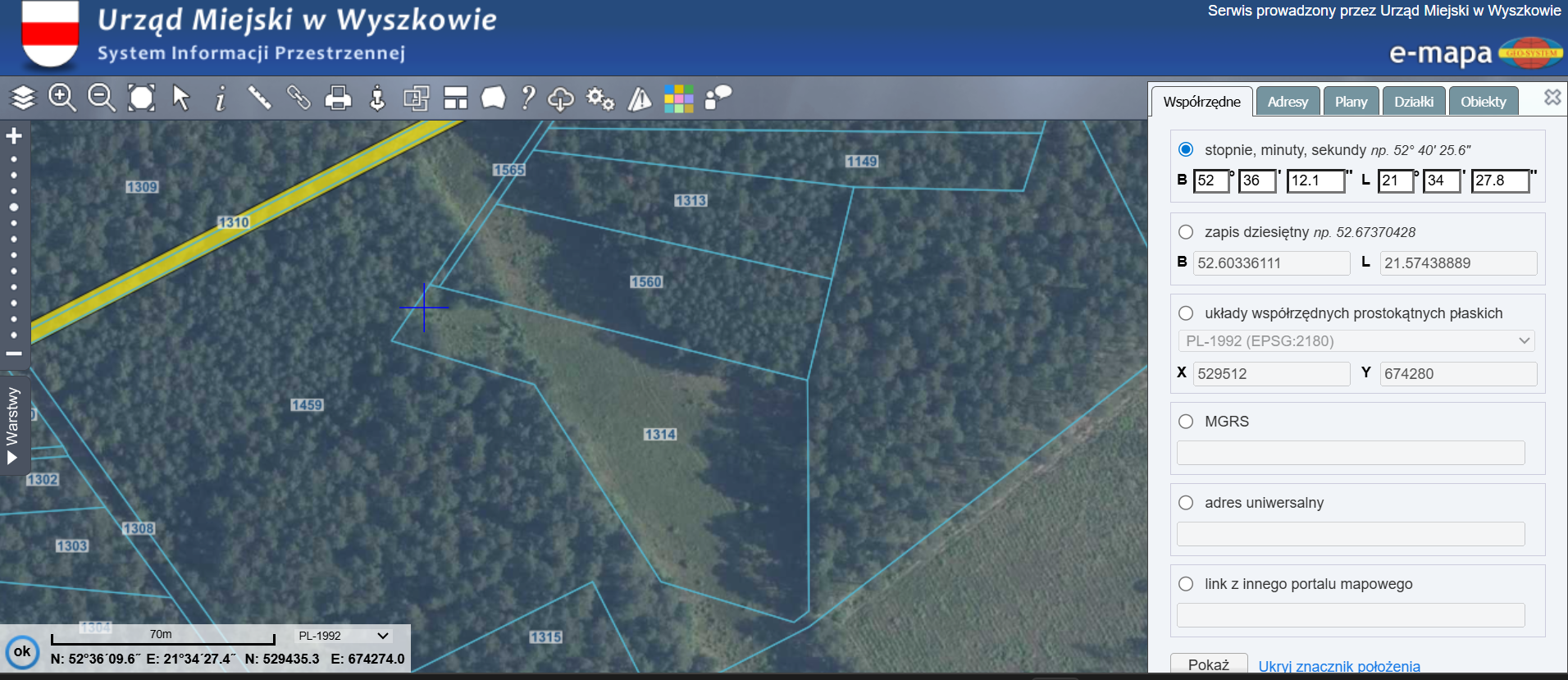
Photo from the Spatial Information System portal of the Wyszków City Hall. The cross marks the indicated location. Source: https://wyszkow.e-mapa.net/ (accessed: December 19, 2025)
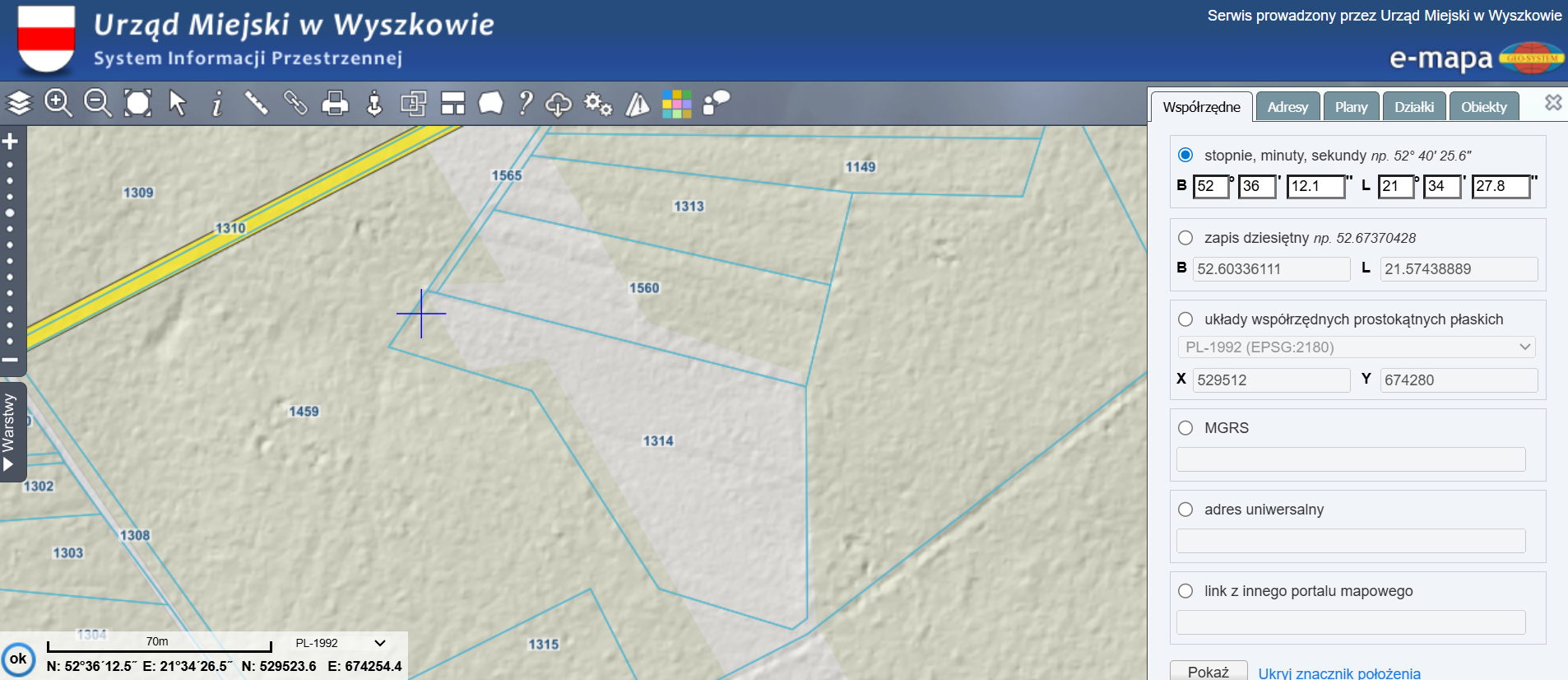
Image of the terrain relief of the same area. Source: https://wyszkow.e-mapa.net/ (accessed: December 19, 2025)
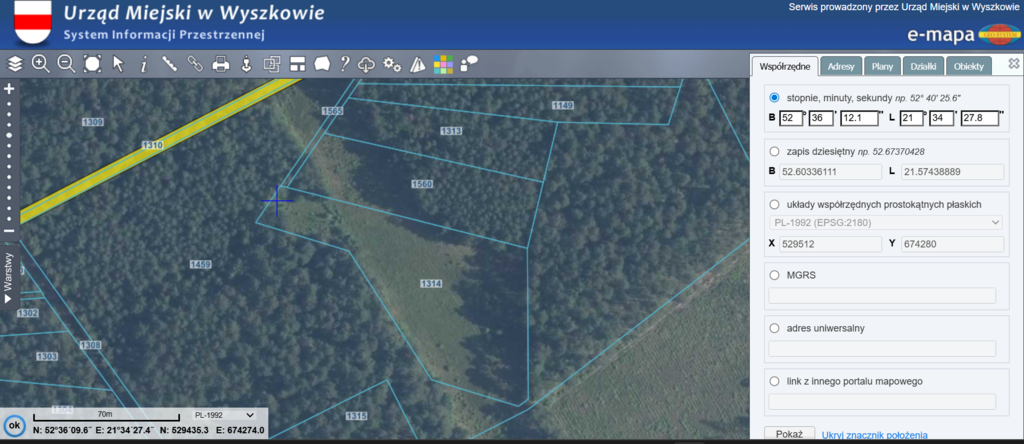 Kamieńczyk - Zdjęcie z portalu Systemu Informacji Przestrzennej Urzędu Miasta w Wyszkowie - Źródło https://wyszkow.e-mapa.net/ (dostęp: 19.12.2025)
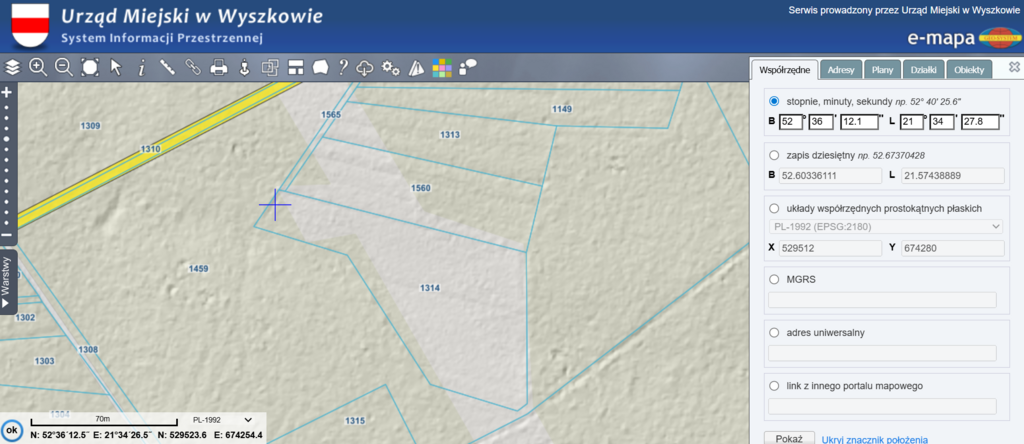 Kamieńczyk - Obraz rzeźby terenu z portalu Systemu Informacji Przestrzennej Urzędu Miasta w Wyszkowie - Źródło https://wyszkow.e-mapa.net/ (dostęp: 19.12.2025)
Sources
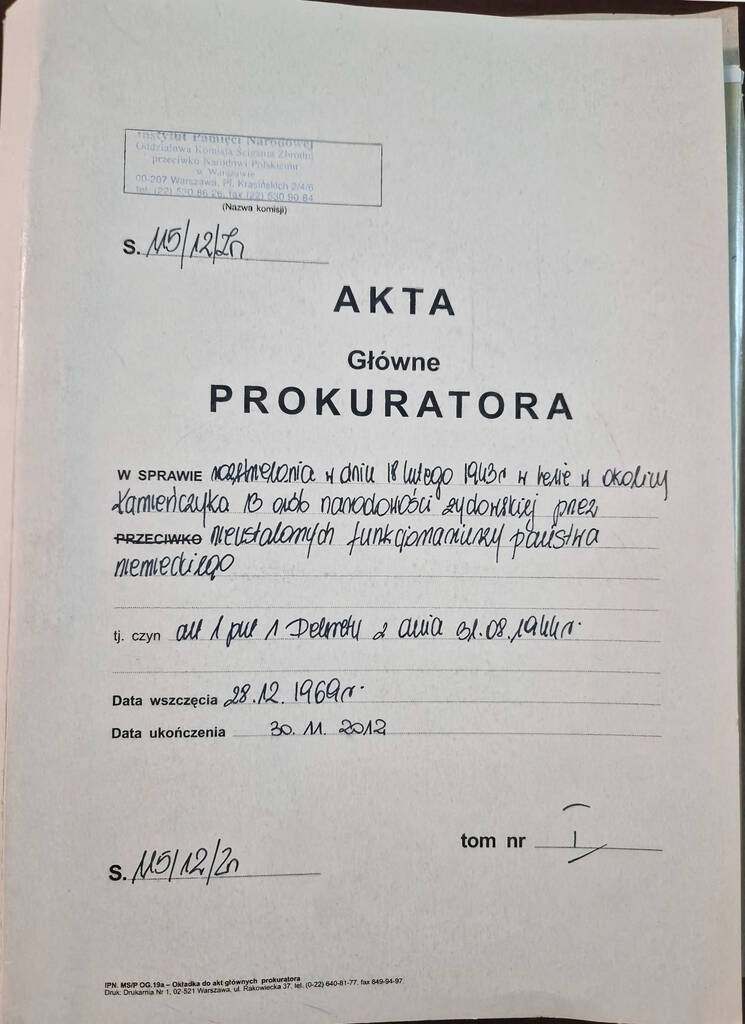 Kamieńczyk Akta Główne Prokuratora w sprawie rozstrzelania w dniu 18 lutego 1943 r. w lesie w okolicy Kamieńczyka 13 osób
Contact and cooperation
We are still looking for information on the identity of the victims and the location of Jewish graves in Kamieńczyk. If you know something more, write to us at the following address: kontakt@zapomniane.org.
Bibliography
Prosecutor’s main case files regarding the shooting of 13 Jewish individuals on February 18, 1943, in the forest near Kamieńczyk by unidentified German state officials.
Recording of the Zapomniane Foundation (audio file), Zbigniew M., born in 1962, interviewed by Agnieszka Nieradko and Andrzej Jankowski, Kamieńczyk, June 7, 2024.
Recording of the Zapomniane Foundation (audio file), Sylwester K., interviewed by Andrzej Jankowski, Kamieńczyk, June 30, 2024.
Recording of the Zapomniane Foundation (audio file), Sylwester K., interviewed by Andrzej Jankowski, Kamieńczyk, August 14, 2025.
The materials published on this website were developed, digitized, and made available thanks to funding from the Minister of Culture and National Heritage through the Culture Promotion Fund, as well as support from the Embassy of the Federal Republic of Germany in Warsaw, which also enabled the creation of the English-language version of the website.